

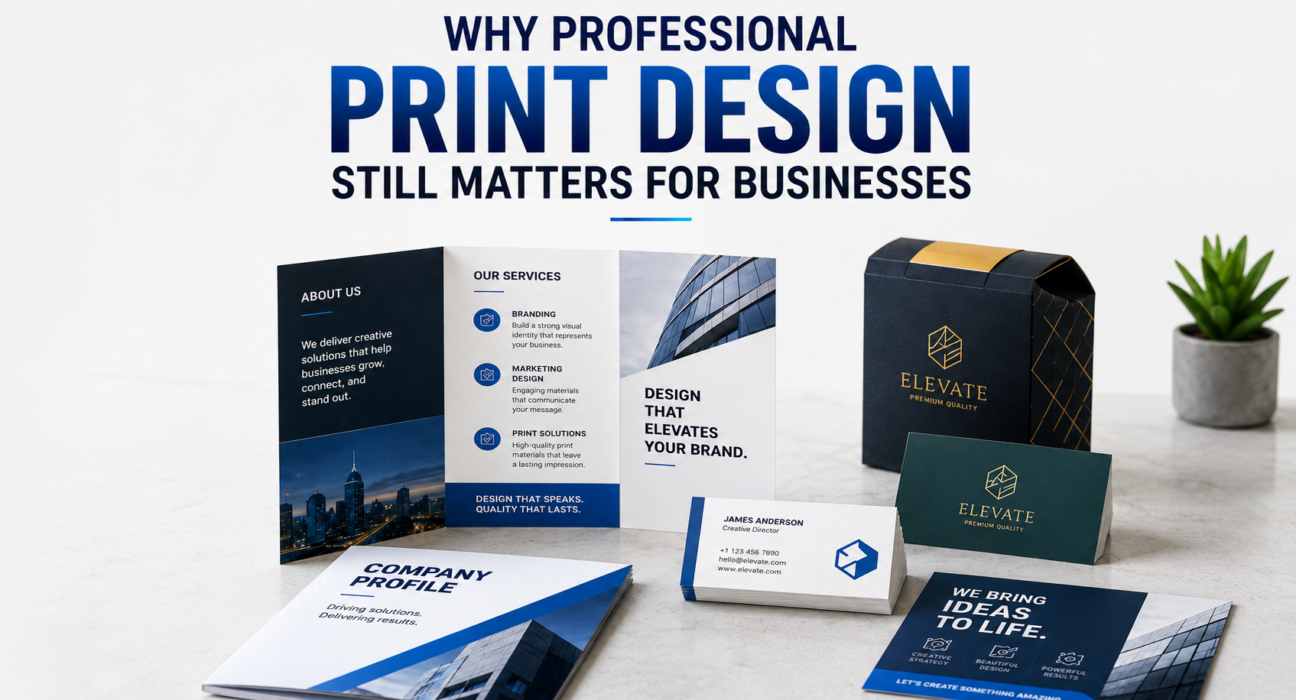
In a world dominated by websites, apps, and social media feeds, it’s easy to assume print is dead. But walk into any successful retail store, trade show booth, or corporate boardroom, and you’ll still find professionally designed brochures, packaging, business cards, and signage doing quiet, effective work. Professional print design isn’t a relic – it’s a deliberate business tool that builds trust, reinforces brand identity, and reaches audiences that digital channels sometimes miss.
For business owners and marketers weighing where to invest limited design budgets, the real question isn’t “print or digital?” It’s “how does print design fit into a modern marketing strategy, and when is it worth hiring a professional?” This article breaks down exactly that.
What Is Print Design, and Why Does It Still Matter?
Print design is the process of creating visual materials – such as brochures, business cards, packaging, signage, and marketing collateral – intended for physical, printed distribution rather than digital screens.
It still matters because physical materials create a tangible, sensory brand experience that digital media cannot replicate. A well-designed print piece communicates professionalism and credibility in ways that a webpage alone often cannot, especially in industries built on trust, such as real estate, healthcare, finance, and B2B services.
Print also has a practical advantage: it doesn’t compete with dozens of open browser tabs or app notifications. A brochure in someone’s hands, a business card on a desk, or packaging on a shelf commands focused attention, even if only briefly.
The Business Case for Professional Print Design
1. First Impressions Still Happen in Person
Despite the shift to digital-first marketing, plenty of business relationships still begin face-to-face – at conferences, client meetings, retail counters, or networking events. A poorly designed business card or handout can undercut an otherwise strong pitch. Professional print design ensures these physical touchpoints reflect the same quality and consistency as a company’s digital presence.
2. Print Builds Credibility and Trust
Studies in consumer psychology consistently show that people associate physical materials with legitimacy. A tangible brochure or catalog can feel more “real” and trustworthy than a purely digital ad, particularly for older demographics or industries where big purchase decisions are involved (real estate, legal services, medical practices, financial planning).
3. Packaging Design Directly Influences Purchase Decisions
For product-based businesses, packaging is often the single most important design asset a company owns. It’s the first physical interaction a customer has with a product, and it needs to communicate brand values, product benefits, and quality – all within a few seconds of shelf time or an unboxing moment.
4. Print Reinforces Brand Consistency Across Channels
Strong brands look and feel the same whether a customer encounters them on a website, in an email, or on a printed flyer. Professional print design ensures fonts, colors, logos, and messaging stay consistent, strengthening brand recognition over time.
5. Print Has Staying Power
Unlike a social media post that disappears within hours, a well-designed print piece can remain visible for weeks, months, or even years – think of a menu on a restaurant table, a poster in an office lobby, or a product box sitting in someone’s home.
Where Print Design Still Delivers Real ROI
| Business Type | High-Impact Print Assets |
|---|---|
| Retail & E-commerce | Product packaging, in-store signage, shelf displays |
| Real Estate | Property brochures, signage, business cards |
| Healthcare | Patient education materials, appointment cards, waiting room signage |
| Restaurants & Hospitality | Menus, table tents, loyalty cards |
| B2B Services | Sales one-pagers, trade show materials, corporate stationery |
| Events & Conferences | Banners, badges, printed programs |
This isn’t an exhaustive list, but it illustrates a pattern: industries where trust, tactile experience, or in-person interaction matter tend to see the strongest returns from professional print design.
Common Print Design Mistakes Businesses Make
Many businesses that skip professional print design – or attempt it in-house without design expertise – run into avoidable problems:
- Inconsistent branding. Colors, fonts, or logos that don’t match the company’s digital brand.
- Poor print-readiness. Files that look fine on screen but print blurry, miscolored, or incorrectly sized because they weren’t set up for print (wrong resolution, missing bleed, incorrect color mode).
- Cluttered layouts. Trying to fit too much information onto a single page, making it hard to read.
- Ignoring the physical format. Designing without considering how a piece will actually be held, folded, or displayed.
- Skipping proofing. Sending files to print without a final quality check, resulting in costly reprints.
A professional print designer understands both the creative and technical requirements – including color profiles (CMYK vs. RGB), bleed and trim settings, paper stock considerations, and finishing options – that prevent these costly errors.
In-House vs. Freelance vs. Agency: How to Approach Print Design
Businesses generally have three options for print design work:
- In-house design team – Best for companies with ongoing, high-volume print needs and existing brand guidelines.
- Freelance designers – A flexible option for smaller projects or businesses with tighter budgets.
- Design agencies – Suited for businesses that need a full brand system, strategic input, or coordination across multiple print and digital assets at once.
For businesses without an internal design function, working with an experienced design agency or specialist often produces more consistent, print-ready results than attempting it internally without dedicated design skills.
How to Choose the Right Print Design Partner
When evaluating a print design agency or freelancer, businesses should look for:
- A portfolio that includes real, printed examples (not just digital mockups)
- Experience with your specific print category (packaging, signage, marketing collateral, etc.)
- Understanding of print production requirements, not just visual design
- Clear communication about timelines, revisions, and printing logistics
- References or case studies from similar industries
Businesses that want to compare multiple technology and design service providers before committing can use platforms like GoFirms to research and evaluate agencies based on their services, specialties, and client focus, making it easier to shortlist a partner suited to specific print design needs.
Print Design and Digital Marketing: Better Together
Print and digital marketing aren’t competitors – they work best as complementary parts of a broader strategy. QR codes on printed materials can drive traffic to websites. Consistent branding across print and digital builds stronger recognition. Direct mail campaigns can be paired with digital retargeting for higher response rates.
Businesses that treat print design as an isolated, outdated line item miss opportunities to create a more cohesive, multi-channel brand experience.
Frequently Asked Questions
Is print design still relevant in a digital-first world? Yes. Print design remains relevant because it creates tangible, trust-building experiences that digital channels can’t fully replicate. Industries like retail, real estate, and healthcare especially benefit from professionally designed physical materials that reinforce credibility and brand consistency.
What’s the difference between print design and graphic design? Graphic design is a broad discipline covering both digital and print visuals. Print design specifically refers to design work intended for physical printed output, requiring knowledge of print-specific technical requirements like resolution, color modes, and bleed settings.
How much does professional print design typically cost? Costs vary widely based on project scope, complexity, and the designer’s experience level. Simple items like business cards cost less than comprehensive packaging or brand collateral systems. It’s best to request quotes from a few providers to compare pricing for a specific project.
Can I design print materials myself using free tools? Basic templates can work for very simple, low-stakes materials. However, DIY designs often lack the technical print-readiness and strategic brand consistency that a professional designer provides, which can lead to costly printing errors or a less polished brand image.
What file formats do professional print designers use? Print designers typically deliver print-ready files in formats like high-resolution PDF, EPS, or native design files (such as Adobe InDesign or Illustrator files) set up with correct color modes and bleed for commercial printing.
Does packaging design count as print design? Yes. Packaging design is a specialized branch of print design that also incorporates structural and material considerations, since packaging must function physically as well as visually.
How do I find a good print design agency? Look for agencies with a strong print portfolio, relevant industry experience, and a clear production process. Research platforms like GoFirms can help businesses compare design agencies based on their focus areas and service offerings before reaching out.
Conclusion
Print design hasn’t lost its relevance – it’s simply found its place alongside digital marketing rather than being replaced by it. For businesses that want to build trust, stand out in person, and create a consistent brand experience across every touchpoint, professional print design remains a smart, strategic investment.
Whether it’s packaging, signage, or marketing collateral, working with an experienced print designer helps avoid costly production mistakes and ensures the final product reflects your brand the way it deserves. Businesses looking to find and compare qualified design agencies can use GoFirms to research providers and make a more informed hiring decision.