

How to Track Telecaller Performance and Productivity
A sales manager checks in at 6 PM. The team made 400 calls today. Is that good? Nobody can say for sure, because nobody agreed on what “good” looks like, and half the numbers are sitting in a notebook or a WhatsApp group instead of one place.
This is the most common problem in outbound sales teams across India. Calls happen, but performance is invisible until the end of the month, when it is too late to fix anything. Proper telecaller performance tracking solves this by turning daily calling activity into numbers you can act on, using telecalling software built to capture calls, follow-ups and outcomes automatically.
This guide explains what to track, how to track it, and how to use that data to build a team that consistently performs better.
What Is Telecaller Performance Tracking?
Telecaller performance tracking is the process of measuring how telecallers spend their working day and how effectively their calls convert into results. It covers activity (calls made, talk time), quality (conversion rate, call quality) and consistency (follow-up completion, attendance) — usually captured through a CRM or dialer rather than manual logs.
Why Tracking Telecaller Performance Matters
Most telecalling teams already collect some data. The problem is that it’s scattered — a call log on one sheet, follow-ups on WhatsApp, conversions in the founder’s head. This creates three specific problems.
Managers can’t coach effectively. Without call-level data, feedback becomes generic (“call more, sell harder”) instead of specific (“your connection rate is fine, but your talk time on qualified leads is too short to build trust”).
Good performers go unnoticed. In a 15-person team, the telecaller who follows up religiously and closes steadily can look identical, on paper, to one who just makes noise with high call volume.
Leads fall through the cracks. When follow-up tracking is manual, callbacks get missed, and a lead that was ready to buy goes cold simply because nobody called back on time.
Tracking performance isn’t about surveillance. It’s about giving managers and telecallers a shared, accurate picture of what’s actually happening on calls, so both sides can improve.
Key Metrics for Telecaller Performance Tracking
Not every metric matters equally. Below are the ones that give the clearest picture of both effort and effectiveness.
| Metric | What It Tells You | Why It Matters |
|---|---|---|
| Calls made per day | Volume of outbound activity | Baseline effort indicator, but not a quality signal on its own |
| Connection / answer rate | % of dialed calls that actually connect | Flags bad data, wrong calling hours, or poor number quality |
| Average talk time | How long calls last | Very short calls often mean rushed pitches or poor qualification |
| Conversion rate | % of calls that move a lead forward | The clearest measure of actual sales effectiveness |
| Follow-up completion rate | % of scheduled callbacks completed on time | Shows discipline and consistency, not just talent |
| Idle time / utilization | Time between calls or logged-in but inactive | Reveals wasted working hours |
| Call quality score | Structure, tone and outcome of individual calls | Separates telecallers who talk a lot from those who talk well |
No single metric tells the full story. A telecaller with high call volume but a low conversion rate is different from one with fewer calls but consistent follow-ups and closures. Look at these numbers together, not in isolation.
A Quick Way to Think About It
If you can only track three things, track connection rate, conversion rate, and follow-up completion. Together, they answer whether calls are reaching people, whether those calls work, and whether leads are being nurtured properly — the three things that actually drive revenue.
How to Track Telecaller Performance: Manual vs CRM-Based
There are two broad approaches, and most growing teams eventually move from the first to the second.
Manual Tracking (Spreadsheets and Registers)
Some small teams still track calls using Excel sheets, physical call registers, or WhatsApp updates. This works for two or three telecallers with low call volumes, but it breaks down quickly:
- Numbers are self-reported, so accuracy depends on discipline, not data.
- There’s no real-time visibility — managers only see results at day-end or week-end.
- Follow-ups are easy to forget because there’s no automated reminder system.
- Comparing telecallers fairly is difficult without a standard format.
CRM-Based Tracking
A telecaller CRM or dialer-based system captures data automatically as calls happen — duration, outcome, timestamp — instead of relying on someone typing it into a sheet afterward. This gives managers:
- Real-time dashboards instead of end-of-day reports
- Automatic call logging, so nothing depends on memory
- Consistent data across the whole team, in the same format
- Historical trends over weeks and months, not just a single day’s snapshot
For teams making more than a handful of calls a day, CRM-based tracking is the only way to get accurate, real-time numbers without adding admin work for telecallers.
Setting Benchmarks and Targets
Tracking numbers only helps if you know what “good” looks like. Benchmarks give context to raw data.
- Start with your own historical average. Look at the last 2–3 months of data (or start collecting it now) to establish a realistic baseline for your team and industry.
- Set targets per role, not per person. A new telecaller and a two-year veteran shouldn’t have identical conversion targets in month one.
- Separate activity targets from outcome targets. Calls-per-day is an activity target; conversion rate is an outcome target. Both matter, but they should be reviewed differently.
- Review and adjust quarterly. Lead quality, seasonality and market conditions change — a target set in January may not be realistic in a slow month.
- Use team averages for context, not punishment. Benchmarking against the team average helps identify who needs coaching, not who needs blame.
Real-World Examples
These examples are illustrative, not case studies of specific customers.
Real estate. A telecalling team following up on 99acres and MagicBricks leads finds that their connection rate is high, but conversion is low. Reviewing call quality scores shows telecallers are pitching site visits too early, before qualifying budget. The fix is a script change, not more calls.
Insurance. A renewal team tracks follow-up completion rate and finds one telecaller consistently misses callback windows near month-end, when workload peaks. Instead of assuming poor performance, the manager redistributes lead volume more evenly across the week.
Education admissions counselling. A coaching institute tracks average talk time on enquiry calls and finds their best-converting counsellors spend nearly double the time per call compared to others — because they answer parent questions instead of rushing to the next lead.
In each case, tracking didn’t just measure performance — it pointed to a specific, fixable cause.
Benefits of Structured Performance Tracking
- Faster, more specific coaching based on actual call data instead of assumptions
- Fairer recognition for telecallers who are consistent, not just loud
- Fewer missed follow-ups, since reminders and overdue alerts are automatic
- Better lead-source decisions — you can see which sources actually convert, not just generate calls
- More accurate forecasting, since pipeline and call data are connected instead of separate
Common Mistakes to Avoid
- Tracking only call volume. High call counts with low conversions usually mean a lead-quality or script problem, not a laziness problem.
- Comparing telecallers without context. A telecaller working fresh leads and one working old, recycled leads should not be judged on the same scale.
- Using performance data only for penalties. If tracking is only ever used to criticize, telecallers will find ways to game the numbers instead of improving them.
- Ignoring follow-up data. Many teams track calls closely but ignore follow-up completion, even though missed callbacks are one of the biggest causes of lost leads.
- Ignoring idle time. Two telecallers with similar call counts can have very different actual working hours — idle time explains the gap.
How TeleCallingCRM Helps Track Telecaller Performance
TeleCallingCRM is built around this exact problem — giving managers real-time visibility instead of end-of-day guesswork. A few relevant capabilities:
- A live war room that shows which agents are on a call, idle, or on a break in real time, along with talk time and utilization
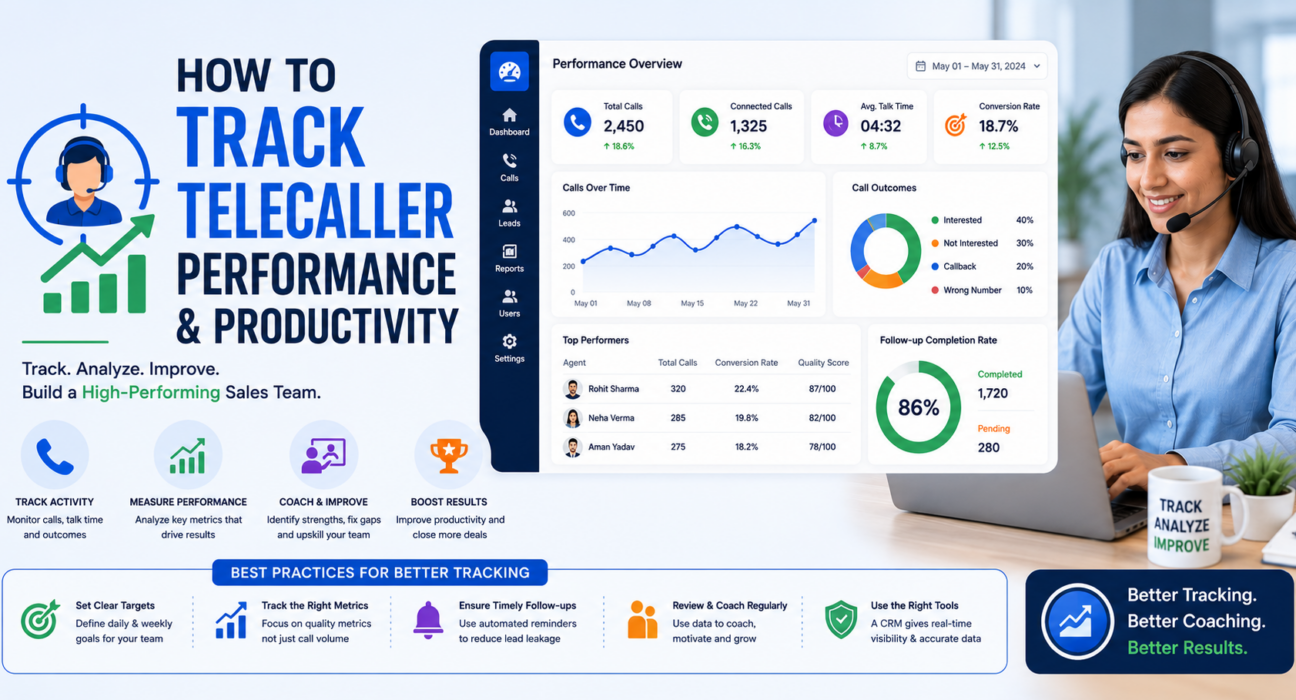
- Real-time analytics dashboards covering connection rate, answer rate, calls made, and pipeline movement
- AI call analysis that automatically transcribes and scores calls, so quality doesn’t rely on manual spot-checks
- Follow-up tracking with reminders and overdue alerts, so callback discipline is measurable, not just assumed
- Leaderboards that rank agents by calls, talk time, conversions or revenue, giving fair, data-backed recognition
This isn’t the only way to track telecaller performance — spreadsheets and manual registers can work for very small teams. But as call volume grows, a system that captures this data automatically removes the guesswork and the admin overhead that manual tracking creates.
Frequently Asked Questions
What is the best metric to measure telecaller performance?
There is no single best metric. Connection rate, conversion rate and follow-up completion together give the clearest picture, since they cover whether calls connect, whether they work, and whether leads are nurtured consistently.
How many calls should a telecaller make per day?
This depends on industry, lead type and call length. Rather than copying a generic number, calculate your own baseline from historical data and adjust it based on connection and conversion rates, not volume alone.
Can telecaller performance be tracked without a CRM?
Yes, using spreadsheets or call registers, but this works only for very small teams. It becomes unreliable and time-consuming as call volume grows, since data has to be entered manually and isn’t available in real time.
How do you track telecaller productivity, not just call count?
Productivity is better measured through utilization (working time vs idle time), talk time, and outcome-based metrics like conversion rate and follow-up completion, rather than raw call counts.
What is a good connection rate for outbound calling?
Connection rates vary by industry, lead source and calling hours, so there is no universal figure. Track your own rate over time and investigate drops, since they usually point to bad data, wrong calling windows or a change in lead source quality.
How does call quality scoring work?
Call quality scoring evaluates individual calls — often using recordings or AI transcription — for factors like structure, objection handling and outcome, giving a score that highlights coaching opportunities beyond what call counts can show.
Should telecaller performance data be shared with the whole team?
Sharing aggregate metrics like leaderboards can build healthy competition, but individual coaching feedback is usually more effective delivered one-on-one, so the goal stays improvement rather than public comparison.
Conclusion
Telecaller performance tracking works best when it combines activity metrics with outcome metrics, and when the data is available in real time rather than reconstructed at month-end. The goal isn’t to watch over telecallers — it’s to give both managers and telecallers a clear, fair picture of what’s working and what needs to change.
Whether you’re using a spreadsheet for a two-person team or a full CRM for telecallers for a growing call center, the principle stays the same: track consistently, review with context, and use the data to coach, not just to judge.