

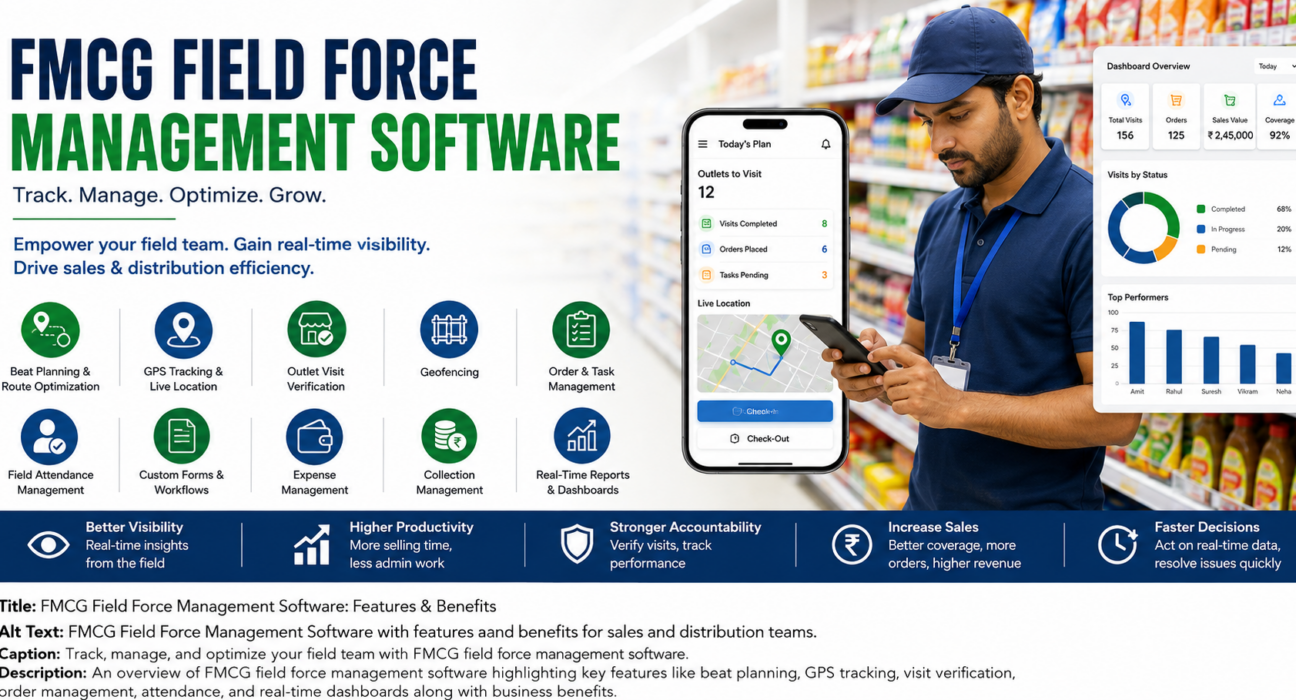
FMCG Field Force Management Software: Features & Benefits
Managing a field team in the FMCG industry is a different challenge than in most other sectors. You’re not tracking a handful of technicians — you’re coordinating dozens or hundreds of sales representatives, distributors, and merchandisers who move through thousands of retail outlets every single day. A FMCG field force management software exists precisely to bring order to that scale.
If you’ve ever struggled to know which outlets your team actually visited, why order volumes don’t match market potential, or why stock-outs keep happening despite a “full” sales team, this article is for you. We’ll break down what FMCG field force management software does, the core features that matter, the benefits it delivers, and how to evaluate the right solution for your business.
What Is FMCG Field Force Management Software?
FMCG field force management software is a digital platform that helps FMCG companies plan, track, and manage the day-to-day activities of their field sales and distribution teams. It typically covers route planning, outlet visits, order booking, attendance, and real-time reporting — replacing manual registers, phone calls, and spreadsheets.
In simple terms: it gives sales and operations leaders visibility into what’s happening in the market, in real time, without needing to physically be there.
Why FMCG Companies Need Field Force Management Software
The FMCG business model depends on high-frequency, high-volume field activity. A single sales representative might be expected to cover 40–50 outlets a day across a defined beat. Multiply that across a regional or national team, and manual tracking simply breaks down.
Common Challenges FMCG Businesses Face Without It
- Limited visibility into field activity — managers don’t know if reps actually visited planned outlets or skipped them.
- Inconsistent beat plans — reps create their own routes, leading to overlapping coverage and neglected outlets.
- Delayed or inaccurate reporting — sales data reaches head office days later, often after manual re-entry errors.
- Stock-outs and missed orders — without real-time order visibility, distributors can’t replenish fast enough.
- Difficulty verifying outlet visits — claims of visits can’t be confirmed without location proof.
- High attrition, low accountability — new reps take time to learn beats, and performance is hard to measure objectively.
These aren’t minor inconveniences. In a category where margins are thin and competition is intense, poor field visibility directly translates to lost sales and higher operational costs.
Core Features of FMCG Field Force Management Software
Not all field force platforms are built the same way, but for FMCG specifically, certain features matter more than others because of the sheer volume and frequency of field activity.
1. Beat Planning and Route Optimization
Beat planning assigns each field representative a structured, repeatable route of outlets to visit on specific days. Instead of reps deciding their own path (or skipping outlets altogether), the software defines optimized routes based on outlet location, visit frequency, and priority.
This ensures:
- Every outlet gets visited on schedule.
- Reps spend less time traveling and more time selling.
- Managers can plan territory coverage strategically, not reactively.
2. GPS Tracking and Real-Time Location Visibility
Live GPS tracking shows where field employees are throughout the day. For FMCG operations spread across wide geographies, this is one of the most valuable features because it turns “trust but can’t verify” into actual visibility.
Managers can see:
- Current location of each field rep.
- Route deviations from the assigned beat.
- Time spent at each outlet.
3. Customer/Outlet Visit Verification
Visit verification confirms that a field rep genuinely visited the outlet they claim to have visited — typically through geo-tagging, geofencing, or photo capture at the point of visit. This directly addresses one of the most common problems in FMCG field operations: unverifiable visit claims.
4. Geofencing
Geofencing creates virtual boundaries around outlets or territories. When a rep enters or exits a defined zone, the system can automatically log check-ins, trigger alerts, or restrict order booking outside approved areas. This reduces manual check-in errors and strengthens visit accuracy.
5. Field Attendance Management
Attendance tracking allows field employees to mark attendance directly from their location using a mobile app, removing the need for physical registers or office check-ins. For a distributed FMCG workforce, this alone significantly cuts down administrative overhead.
6. Order and Task Management
Reps can log orders, capture outlet requirements, and update task status directly from the field. This data flows back to the office in real time, rather than being manually entered at the end of the day or week.
7. Custom Forms and Workflows
FMCG operations often need to capture more than just orders — shelf availability, competitor pricing, promotional compliance, or merchandising checks. Custom forms let businesses build these data-capture workflows without needing separate tools.
8. Expense Management
Field reps typically incur travel, fuel, and daily allowance expenses. Digitizing expense claims and approvals reduces reconciliation delays and gives finance teams a clearer, auditable trail.
9. Collection Management
For FMCG distributors extending credit to retailers, tracking payment collections in the field is critical. Digital collection tracking connects field activity directly to receivables, reducing the gap between sales and cash flow visibility.
10. Real-Time Reporting and Dashboards
Perhaps the most important capability overall: real-time dashboards that consolidate attendance, visits, orders, and productivity data into a single view. This is what allows leadership to make decisions based on current market activity rather than last week’s data.
Key Benefits of FMCG Field Force Management Software
| Benefit | Impact on Business |
|---|---|
| Improved field visibility | Managers know exactly what’s happening in the market at any given time |
| Better outlet coverage | Structured beat plans ensure no outlet is missed or over-visited |
| Faster, accurate reporting | Real-time data replaces delayed manual reports |
| Reduced fraudulent claims | GPS and geofencing verify actual visits |
| Improved field productivity | Less time on admin and unplanned travel, more time selling |
| Better sales forecasting | Consistent order and visit data improves demand planning |
| Stronger accountability | Individual and team performance becomes measurable |
| Faster issue resolution | Real-time alerts flag deviations or missed targets immediately |
How FMCG Businesses Can Choose the Right Field Force Management Software
When evaluating a solution, it helps to look beyond the feature list and consider fit for your specific operating model.
Questions worth asking:
- Does it support beat planning and route optimization at scale?
- Can it verify outlet visits with GPS or geofencing, not just self-reported check-ins?
- Does it offer real-time dashboards, or only end-of-day reports?
- Can it handle order booking, collections, and expense tracking in one place?
- Is the mobile app simple enough for field reps with varying levels of tech familiarity?
- Can workflows and forms be customized to your specific reporting needs?
- Does it integrate with your existing distribution or ERP systems?
Businesses looking to simplify these processes can use field force management software such as FieldExecutives, which brings together beat planning, GPS tracking, attendance, visit verification, and real-time reporting in a single platform built for field-heavy operations like FMCG sales and distribution.
If you’re currently relying on spreadsheets, phone calls, or fragmented tools, the transition to a dedicated platform is usually the point where field visibility and accountability improve most noticeably.
Best Practices for Implementing Field Force Management Software in FMCG
- Start with a pilot team or region before rolling out company-wide, so you can refine beat plans and workflows.
- Train field reps thoroughly on the mobile app — adoption depends heavily on ease of use.
- Define clear KPIs (visit compliance, order value, coverage percentage) before go-live so success is measurable.
- Review dashboards regularly, not just during audits — the value comes from acting on real-time data.
- Iterate on beat plans using actual visit and sales data, rather than treating the initial plan as fixed.
Conclusion
FMCG field operations run on scale, frequency, and consistency — and manual tracking methods simply can’t keep up. A dedicated FMCG field force management software brings structure to beat planning, verifies field activity, and gives leadership real-time visibility into what’s actually happening across the market.
The result isn’t just better reporting — it’s fewer missed outlets, faster issue resolution, and a field team that’s more accountable and more productive. If your current process still depends on phone calls and spreadsheets, it may be time to explore a platform like FieldExecutives, built specifically to handle the demands of field-heavy operations like FMCG sales and distribution.