

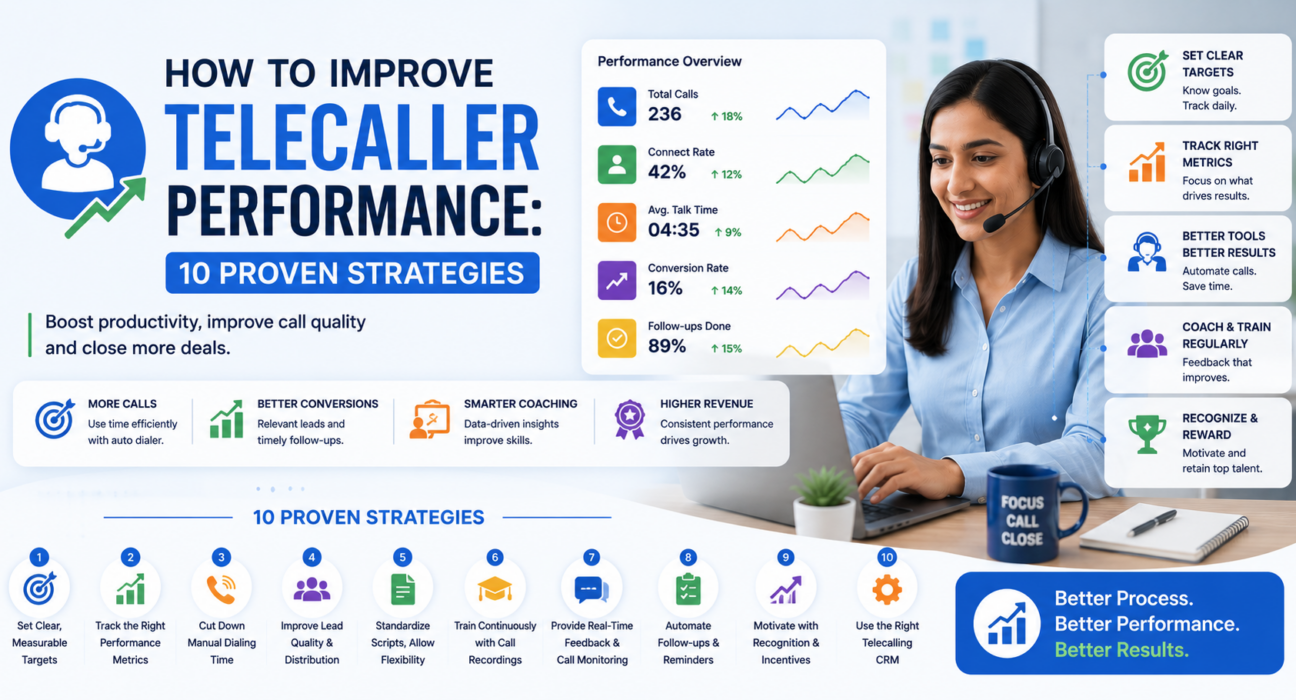
How to Improve Telecaller Performance: 10 Proven Strategies
Two telecallers can work off the exact same lead list and get completely different results. One closes twice as many deals, follows up on time, and keeps prospects engaged. The other struggles to keep pace, forgets callbacks, and burns through leads with little to show for it.
The difference is rarely talent alone. It usually comes down to process, discipline, and the tools available to the telecaller. Businesses that want steady, repeatable results usually pair skill training with a telecaller CRM built for performance tracking, which removes manual work and gives managers real visibility into what is actually happening on calls.
This article covers 10 practical strategies to improve telecaller performance — useful whether you manage a two-person outbound team or a 50-agent call floor.
What Determines Telecaller Performance?
Telecaller performance depends on four things working together: lead quality, call discipline (how consistently a telecaller dials and follows up), calling skill (pitch, objection handling, tone), and the tools available to reduce manual work. Improving just one factor helps a little. Improving all four together is what produces lasting results.
Why Telecaller Performance Directly Affects Revenue
In outbound sales, telesales and support-led selling, revenue is largely decided by call activity, not marketing spend alone. A real estate counsellor who calls back an interested buyer within the hour has a real shot at closing. The same buyer, called three days later, has usually already spoken to a competitor.
This is true across industries. Insurance renewals, education admissions, recruitment placements, and B2B lead qualification all depend on how quickly and consistently a telecaller follows up. When performance drops, it rarely shows up as one big problem — it shows up as slower connect rates, missed callbacks, and leads quietly going cold.
10 Proven Strategies to Improve Telecaller Performance
1. Set Clear, Measurable Daily and Weekly Targets
Vague goals like “call more leads” don’t give telecallers anything to work towards. Set specific, achievable targets — for example, a fixed number of dials per day, a minimum talk-time goal, or a target number of follow-ups completed.
Targets work best when they are visible to the telecaller in real time, not just reviewed at the end of the week. Seeing “I’m at 32 of 50 calls” by 3 PM changes behaviour far more than a number shared the next morning.
2. Track the Right Performance Metrics, Not Just Call Counts
Call volume alone is a weak indicator of performance. A telecaller making 100 short, rushed calls a day may convert far fewer leads than one making 60 well-handled calls. Track a combination of metrics instead.
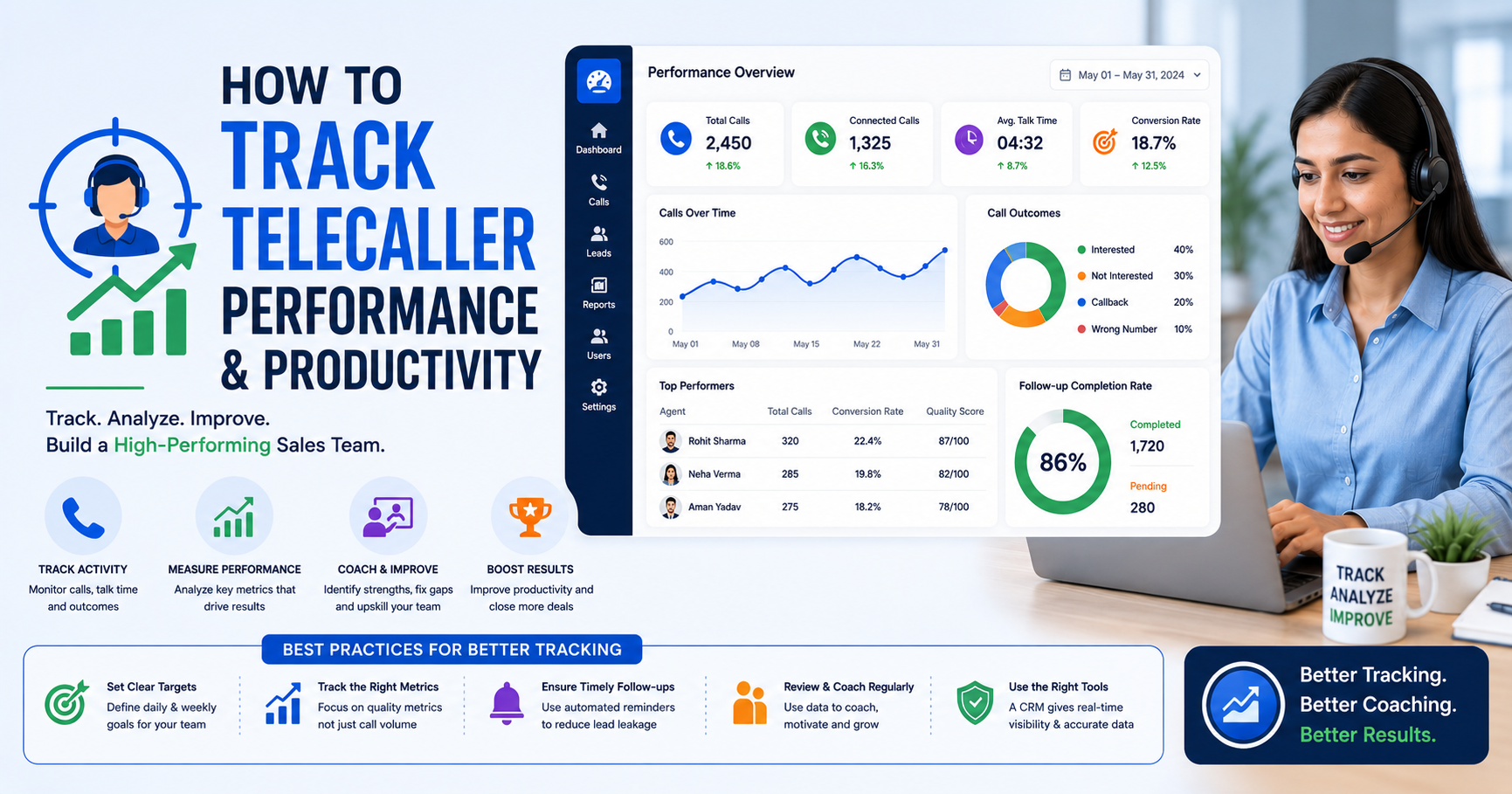
| Metric | What It Shows | Why It Matters |
|---|---|---|
| Connect rate | % of dials that reach a live person | Low connect rate often points to bad data or wrong calling hours |
| Average talk time | How long calls actually last | Very short calls usually mean weak pitching or poor engagement |
| Follow-up completion rate | % of scheduled callbacks actually made | Directly tied to lead leakage |
| Conversion rate | Leads that turn into a sale or next stage | The real measure of effectiveness |
| Lead response time | Time between lead arrival and first call | Faster response almost always improves conversion |
3. Cut Down Manual Dialing Time
Manually looking up a number, dialing, and waiting for a connection wastes a significant part of a telecaller’s day. Sales calling software with an auto dialer removes this friction by dialing through an assigned list automatically, capturing call duration, and letting the telecaller log the outcome in one tap.
This alone can meaningfully increase the number of productive conversations a telecaller has in a day, simply by removing dead time between calls.
4. Improve Lead Quality and Distribution
Even the best telecaller struggles with poor-quality or badly distributed leads. If hot leads sit unassigned for hours, or the same lead is called by two different agents, performance suffers regardless of individual skill.
A lead management software system that scores leads (hot, warm, cold) and auto-assigns them based on rules like language match or agent availability solves this at the source. For example, a recruitment firm handling candidates across multiple cities can route each lead to an agent who speaks the candidate’s preferred language, rather than assigning leads randomly.
5. Standardize Call Scripts, But Allow Flexibility
A script gives new telecallers a safety net and keeps messaging consistent across the team. But a script read word-for-word, without adapting to the conversation, sounds robotic and hurts trust.
The better approach is a structured script with clear talking points for common objections, paired with training on when to deviate. Stage-aware scripts — where the talking points change based on where the lead is in the pipeline — tend to work better than one generic script for every call.
6. Build a Reliable Follow-Up System
Most lost sales in telecalling are not lost on the first call — they’re lost because the follow-up never happened. A telecaller juggling 200 leads on a spreadsheet cannot reliably remember which prospect needs a callback on which day.
Lead follow-up software that schedules reminders automatically, flags overdue callbacks, and prioritises hot leads for earlier follow-up removes this entirely from the telecaller’s memory. For an insurance agency managing policy renewals, this kind of system can be the difference between a renewed policy and a lapsed one.
7. Give Telecallers Real-Time Visibility Into Their Own Numbers
Telecallers who only find out how they performed at the end of the week have no chance to course-correct during the day. Real-time dashboards showing calls made, talk time, and conversions — visible to the telecaller, not just the manager — create a sense of ownership.
Some teams display this on a shared screen, similar to a live war room view, so the whole floor can see activity as it happens. This works particularly well for larger teams where healthy visibility drives urgency without needing constant manager intervention.
8. Use Call Recordings for Coaching, Not Just Monitoring
Call recordings are often used purely to check compliance or catch mistakes. Used differently — as coaching material — they become one of the most effective performance tools available.
Listening to a recorded call with a telecaller, pointing out exactly where the objection handling worked or where interest was lost, is far more useful than generic feedback like “improve your pitch.” Some CRMs now auto-summarise and score calls, which reduces the manual review time this normally takes.
9. Introduce Healthy Competition With Leaderboards
Ranking telecallers by calls made, conversions, or revenue closed — visible to the whole team — tends to lift overall activity, especially among mid-performers who are motivated by visible comparison. This works best when the leaderboard rewards multiple metrics (not just call count), so it doesn’t encourage rushed, low-quality calling purely to top the board.
10. Base Training on Data, Not Assumptions
Generic sales training helps to a point, but targeted coaching based on actual performance data is more effective. If a telecaller has a strong connect rate but a weak conversion rate, the issue is likely pitch or objection handling — not calling discipline. If connect rate itself is low, the problem might be timing, lead quality, or even outdated phone numbers.
Reviewing metrics regularly and coaching to the specific gap, rather than repeating the same generic training for everyone, produces faster improvement.
Common Mistakes That Hurt Telecaller Performance
- Overloading telecallers with too many leads at once, leading to rushed, low-quality calls.
- Ignoring calling-hour compliance. Under TRAI regulations, promotional calls are not permitted between 9 PM and 9 AM, even to numbers not registered on the Do Not Disturb list.TRAI has also set time-of-day restrictions on telemarketing: promotional calls or texts are not allowed between 9:00 PM and 9:00 AM to prevent nuisance during off hours Calling outside this window risks complaints and wasted effort on non-connects.
- Measuring only call volume, which can encourage quantity over quality.
- Delayed lead assignment, where hot leads sit unattended for hours before anyone calls.
- Using recordings only to catch errors, instead of using them to coach and improve.
- Skipping onboarding for new telecallers, expecting them to learn the product and pitch purely through trial and error on live calls.
How a Telecaller CRM Supports These Strategies
Most of the strategies above are hard to sustain manually, especially as a team grows past a handful of agents. This is where a dedicated CRM for telecallers earns its place — not as a replacement for good management, but as the system that makes good management possible at scale.
TeleCallingCRM, for instance, combines a smart auto dialer, lead scoring and auto-assignment, follow-up reminders, call recording, and a real-time analytics dashboard in one platform. It also includes AI call analysis that auto-transcribes and scores calls, which reduces the manual effort needed for coaching-based reviews. Call centers and outbound teams handling high lead volumes can see how this applies specifically to their setup on the call center CRM page.
The goal of any telecalling software should be to remove friction from the telecaller’s day — less manual dialing, less spreadsheet chasing, more time actually talking to prospects.
Frequently Asked Questions
What is the single most important metric for telecaller performance?
There isn’t one universal metric — it depends on where the bottleneck is. If leads are being reached but not converting, focus on conversion rate. If leads aren’t being reached at all, focus on connect rate and lead response time first.
Can telecaller performance improve without hiring more people?
Yes. Reducing manual work (like dialing and lead lookup), improving lead distribution, and tightening follow-up discipline often lifts performance more than adding headcount, especially for small teams.
Does an auto dialer really improve performance, or is it just convenience?
It’s both. Beyond convenience, it removes idle time between calls, which directly increases the number of conversations a telecaller can have in a working day.
How do I motivate telecallers without discouraging low performers?
Use leaderboards based on multiple metrics, not just one number, and pair public recognition with private, data-based coaching for those who are struggling.
What causes low telecaller performance in new teams?
Usually a mix of unclear targets, poor lead quality, no structured follow-up system, and insufficient onboarding on the product or pitch.
Can a CRM alone fix poor telecaller performance?
No. A CRM removes friction and gives visibility, but it cannot fix weak coaching, unrealistic targets, or a genuinely poor lead source. It works best alongside good management.
How often should telecaller performance be reviewed?
Daily for activity metrics like calls and follow-ups, and weekly or bi-weekly for deeper metrics like conversion rate and coaching needs.
Conclusion
Improving telecaller performance is rarely about one big fix. It comes from stacking small, consistent improvements — clearer targets, better lead distribution, less manual work, and coaching based on real data instead of guesswork. Teams that get the basics right first, and then add the right tools, tend to see the most durable improvement.
If your team is still managing leads on spreadsheets or dialing manually, it may be worth looking at an affordable telecaller CRM that brings dialing, lead management, and reporting into one place — so your telecallers can spend more of their day actually talking to prospects.