

When enterprise software projects fail, the post-mortem often points to “poor user adoption” or “misalignment with business needs.” What gets missed is the root cause: a fundamental disconnect between how the business actually operates and how the system was designed to work.
This isn’t a technology problem. It’s an execution problem that stems from treating user experience as a design layer instead of a business process imperative.
Most C-level executives have seen this play out. A new ERP goes live, but field teams continue using spreadsheets. A customer portal launches, but the call centre still handles most requests manually. A procurement system gets implemented, but approvals remain stuck in email chains. The software works fine in demos. It just doesn’t work in practice.
The gap between what was built and what was needed usually comes down to one thing: business processes and user experience were designed in isolation from each other.
Why Enterprise Systems Struggle with Process-UX Alignment
Large organisations are complex environments. Multiple departments, legacy workflows, regulatory requirements, regional variations, and decades of institutional knowledge all shape how work actually gets done. When you’re implementing enterprise software across such an environment, alignment isn’t something you achieve through workshops and wireframes alone.
The typical enterprise software implementation follows a familiar pattern. Business requirements get documented. Technical specifications get written. Development happens in phases. UAT gets conducted. Go-live happens. And then reality hits.
What went wrong? Usually, the business process mapping happened without considering the user’s actual workflow. Or the UX design happened without understanding process constraints. Sometimes both happened, but at different times, by different teams, with different assumptions.
Consider a common scenario: implementing a new vendor management system across a large manufacturing company. The procurement policy says all purchases above a certain threshold need three approvals. Simple enough. But in practice, one approver is always travelling, another manages 200+ requests monthly, and the third needs supporting documentation that varies by category. The system requires sequential approvals. The business needs parallel workflows with intelligent routing. The users need context, not just forms.
This isn’t an edge case. It’s normal enterprise complexity.
The software might be functionally correct according to specifications, but it doesn’t align with how decisions actually flow through the organisation. Users find workarounds. Adoption suffers. Business objectives don’t get met.
What Actually Goes Wrong in Large Programs
Enterprise transformation programs typically fail not because of bad technology choices, but because of execution gaps that compound over time.
Stakeholder alignment looks solid in the beginning. Everyone agrees on objectives during the kickoff. But six months into implementation, finance wants different reports than operations, IT wants centralised control while business units want flexibility, and the compliance team has requirements nobody discussed in the original scope.
This isn’t anyone’s fault. Large organisations have legitimate competing priorities. The problem is when these conflicts surface late in the cycle, after core design decisions are locked in.
Process documentation is another common gap. Many enterprises don’t actually know all their processes in detail until they try to implement new software. What people say happens and what actually happens can be quite different. Regional offices develop their own variations. Experienced staff carry process knowledge that never got formally documented. Exception handling, which represents 30% of actual work, gets mentioned as an afterthought.
When UX design happens without this real process understanding, you end up with interfaces that look clean but don’t support the actual work. Or worse, you end up forcing new processes on users without considering whether those processes actually make business sense.
Governance structures also tend to be weak in this area. There’s usually a steering committee for the overall program, technical governance for architecture decisions, and change management for communications. But who owns the alignment between process and experience? Who has the authority to say “this workflow doesn’t match our business reality” and actually get it changed?
These gaps become expensive. Rework happens late in the cycle when it’s most costly. User acceptance testing reveals fundamental misalignments that require design changes. Training becomes harder because the system doesn’t match mental models. Post-go-live support volumes spike because users struggle with unintuitive workflows.
The financial impact extends beyond the project budget. Delayed benefits realisation, lower productivity during transition, ongoing workarounds that create technical debt, all these costs accumulate but often don’t get measured against the original business case.
The Vendor Management Challenge
Enterprise software programs typically involve multiple vendors: package providers, implementation partners, infrastructure teams, integration specialists, and managed service providers. Each vendor has their own scope, their own methodology, and their own definition of done.
Process-UX alignment tends to fall in the gaps between these vendors. The package vendor says their software supports the required workflows. The implementation partner configures according to specifications. The UX agency designs based on provided requirements. Everyone delivers their scope, but the integrated result doesn’t work smoothly.
Who’s responsible? Technically, everyone. Practically, no one.
This is where strong program leadership becomes critical. Someone needs to own the end-to-end outcome, not just coordinate vendor deliverables. That ownership includes catching misalignments early, making decisions when requirements conflict, and ensuring the integrated solution actually serves the business need.
Many enterprises struggle with this because they structure vendor relationships around component delivery rather than business outcomes. Contracts define features, timelines, and acceptance criteria, but not whether the solution actually improves how work gets done.
Changing this requires a different approach to vendor selection and management. The right partner isn’t necessarily the one with the most impressive demo or the lowest bid. It’s the one that understands your business context, asks uncomfortable questions about process realities, and has demonstrated the ability to deliver integrated solutions that actually work in complex environments.
What Separates Success from Failure
Successful enterprise programs do several things differently when it comes to process-UX alignment.
They start with real process discovery, not just documented procedures. This means observing how work actually happens, understanding exceptions and variations, identifying pain points that users have learned to work around, and documenting the informal knowledge that makes things run smoothly.
This discovery needs to happen early, before design decisions get locked in. And it needs to involve the people who actually do the work, not just their managers. A procurement officer who processes 50 purchase orders daily knows things that don’t appear in any process manual.
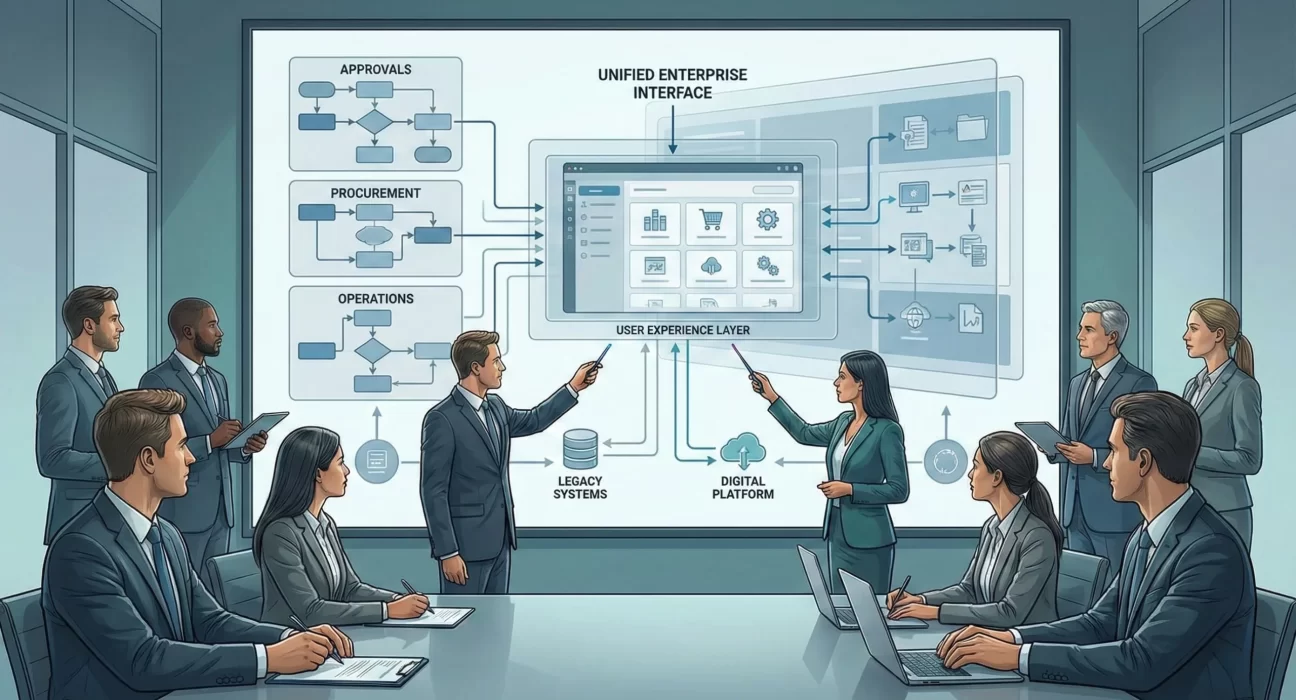
Next, they design processes and experience together, not sequentially. The question isn’t “what UX do we put on this process” but rather “what’s the right process and how should users interact with it.” Sometimes the answer is to change the process. Sometimes it’s to create multiple paths for different scenarios. Sometimes it’s to automate steps that don’t need human judgment.
This integrated design requires collaboration between business process owners, technology teams, and user experience specialists. Not in separate work streams that sync up periodically, but in actual joint working sessions where decisions get made together.
Successful programs also prototype and test early with real users doing real work. Not usability testing with sanitised scenarios, but actual pilots where people use the system to accomplish their daily tasks, with all the complexity and exceptions that entails.
This early validation catches misalignments when they’re still cheap to fix. It also builds user confidence and generates practical feedback that improves the final solution.
Governance matters too. There needs to be clear ownership of the process-UX alignment throughout the program lifecycle. This usually sits with a senior business leader who has authority to make decisions that span departments, understands both operational realities and strategic objectives, and can push back on technical solutions that don’t serve business needs.
Change management in successful programs focuses on process adoption, not just system training. Users need to understand not just how to use the new software, but why the new process is better, how it fits into the bigger picture, and what support is available when they encounter edge cases.
The Role of the Right Partner
Enterprise transformation is not a one-time project. It’s an ongoing journey of improvement, adaptation, and optimization. The systems you implement today will need to evolve as your business grows, regulations change, and new capabilities become available.
This long-term perspective changes how you think about partners. You’re not just buying implementation services. You’re establishing a relationship with someone who will help you navigate complexity, manage change, and deliver sustained business value.
Partners who understand this don’t just deliver to specifications. They challenge assumptions, highlight risks, share experience from similar programs, and take ownership of outcomes. They’ve seen what works and what doesn’t across different industries and different scales.
Ozrit, for example, works with enterprises on this basis as a delivery partner that understands the difference between completing tasks and achieving business results. The focus isn’t on convincing you that transformation is easy. It’s on helping you execute it properly, with eyes wide open about the real challenges involved.
The right partner also brings maturity in execution disciplines that many enterprises lack internally. Program governance frameworks that actually get used. Risk management that catches issues before they become crises. Quality processes that verify alignment, not just functionality. Integration approaches that account for legacy constraints and future flexibility.
This execution maturity matters as much as technical capability. A brilliant architectural design that can’t be delivered on time and budget doesn’t help anyone. A functional system that users reject doesn’t create value.
Making It Work in Your Context
Every enterprise is different. What works for a manufacturing company won’t be identical to what works for a financial services firm or a retail chain. Your regulatory environment, competitive pressures, legacy constraints, and cultural factors all shape the right approach.
But some principles hold across contexts.
Start by being honest about your current state. How well do you really understand your processes? Not the documented versions, the actual ones. How aligned are your stakeholders on priorities? Do you have the internal capability to manage a complex program, or do you need to strengthen it?
Be clear about what you’re optimising for. Faster implementation? Lower risk? Better user adoption? Future flexibility? You can’t maximize everything simultaneously. Make conscious trade-offs based on your business priorities.
Invest in getting the foundations right. Proper discovery, clear governance, integrated design, early validation. These activities feel slow at first, but they prevent expensive rework later.
Choose vendors and partners based on their ability to deliver in complex environments, not just their product features or hourly rates. Check references carefully. Talk to clients who did similar programs at a similar scale.
Plan for the long term from day one. Your implementation approach should account for how the system will be maintained, enhanced, and evolved over time. Vendor lock-in, skill availability, total cost of ownership, these factors matter.
Stay engaged as a leadership team throughout the program. This isn’t something you can delegate completely. Key decisions about process changes, scope adjustments, and resource allocation need senior judgment.
The Path Forward
Aligning business processes and user experience in enterprise systems isn’t a solved problem. It requires ongoing attention, judgment, and course correction. Technology keeps evolving, business needs keep changing, and user expectations keep rising.
What doesn’t change is the need for strong execution, clear ownership, and genuine partnership between business and technology teams.
The enterprises that get this right don’t necessarily have bigger budgets or better technology. They have better discipline in how they approach transformation. They ask harder questions upfront. They make deliberate choices about process and experience together. They hold themselves and their partners accountable for real business outcomes, not just delivered features.
They also recognise that enterprise transformation is fundamentally a people challenge, not a technology challenge. The software enables change. People make it real.
If you’re planning or in the middle of a large-scale program, the questions worth asking are: Do we really understand how work gets done today? Are we designing processes and experiences as an integrated whole? Do we have the governance and partnership in place to execute this properly? Are we set up to sustain this beyond go-live?
The answers to these questions matter more than your technology choices. Getting them right is what separates programs that deliver lasting value from those that become expensive lessons in what not to do next time.