


Introduction
Before signing a lease or buying a single mattress, most first-time PG owners want one number: how much does it actually cost to start? The honest answer is that PG business startup costs in India vary widely by city, property size, and the level of furnishing you offer, but the cost categories themselves are fairly consistent across the country.
This guide breaks down exactly where your money goes when starting a PG, from the property deposit to licenses, furnishing, staff, and working capital, so you can build a realistic budget instead of guessing. Once the business is running, many owners turn to PGCRM, a PG and hostel management software to keep rent, occupancy, and expenses organised from day one.
What Determines PG Business Startup Cost?
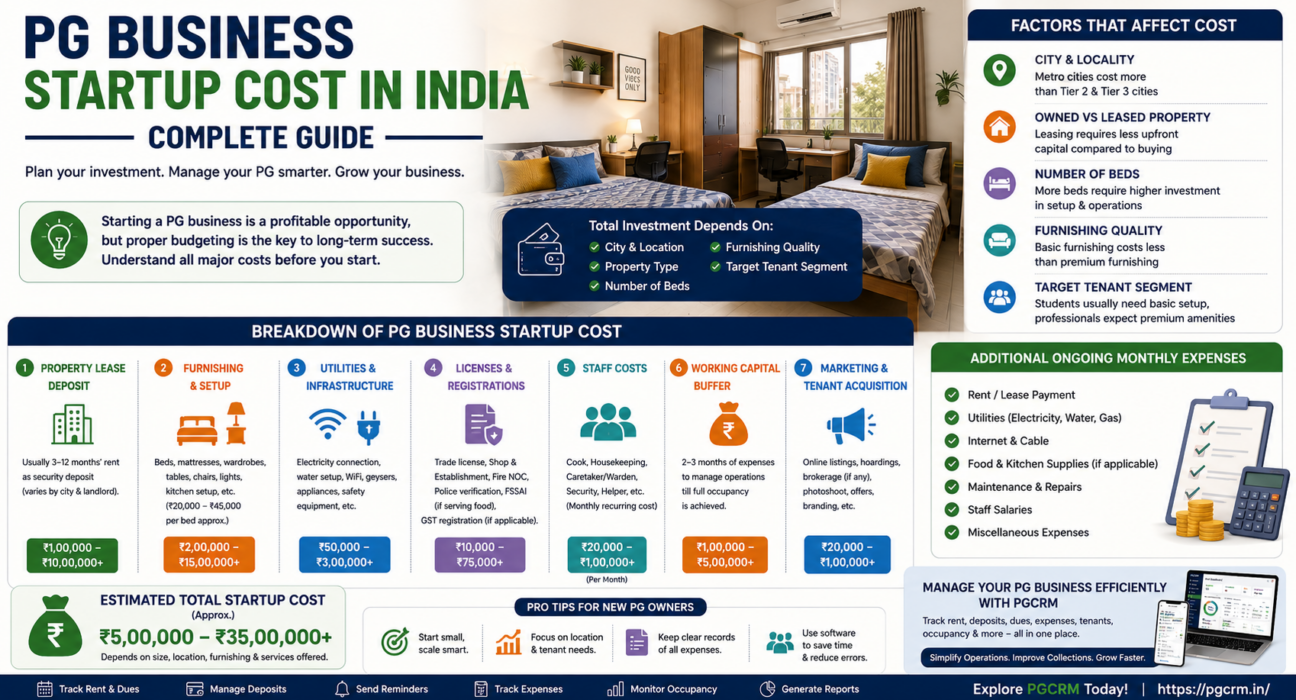
PG business startup costs are shaped by a handful of core factors, and understanding these before budgeting helps avoid underestimating your total investment.
- City and locality – a PG near a business hub in Bangalore or Gurugram costs significantly more to lease and furnish than one in a smaller city.
- Owned vs leased property – Leasing keeps upfront costs lower and is the common starting point for most first-time PG owners, while purchasing property adds a large capital outlay.
- Number of beds – a 10-bed PG has a fundamentally different cost structure than a 40-bed PG, especially for furnishing and staff.
- Furnishing quality – basic furnishing costs less than premium, fully equipped rooms with attached bathrooms and appliances.
- Target tenant segment – student-focused PGs typically need lower-cost furnishing than PGs targeting working professionals who expect more amenities.
Breaking Down PG Business Startup Cost by Category
1. Property Lease Deposit
For most first-time owners, leasing a property is more practical than buying one, since it requires far less upfront capital. Lease deposits for commercial or residential properties used as PGs are usually a multiple of the monthly rent, commonly ranging from a few months’ rent to a year’s rent depending on the city and landlord expectations. This is typically the single largest upfront cost in starting a PG.
2. Furnishing and Setup
Furnishing includes beds, mattresses, wardrobes, study tables, lighting, and, in many PGs, kitchen and common-area setup. Industry estimates suggest furnishing costs commonly fall somewhere in the range of ₹20,000 to ₹45,000 per bed, depending on furnishing quality, with total furnishing investment for a mid-sized PG often running into several lakhs. These figures vary considerably by city and vendor, so it’s worth getting local quotes before finalising a budget.
3. Utilities and Infrastructure Setup
This covers electricity connections, water supply, internet, geysers, kitchen appliances if meals are provided, and basic safety equipment like fire extinguishers. Utility and infrastructure setup costs vary by property condition, since an older building may need more upgrades than a newly constructed one.
4. Licenses and Registration
PG businesses in India typically need to handle a few recurring compliance requirements, though exact rules vary by state and municipality:
- Trade licence from the local municipal corporation, required to legally operate a commercial accommodation business.
- Shop and establishment registration, mandatory in most states for accommodation businesses.
- Fire safety NOC, especially for larger properties or buildings above a certain height or bed count.
- Tenant police verification, commonly required for PGs in most cities as a safety and compliance measure.
- FSSAI licence, if the PG serves food to residents.
- GST registration, required once annual turnover crosses the applicable threshold (₹20 lakh for services in most states).
Registration and licence fees are usually modest compared to property and furnishing costs, but skipping them creates legal risk later, so they should be budgeted for from the start rather than treated as optional.
5. Staff Costs
Depending on the size of the PG, staff may include a cook, housekeeping staff, a warden or caretaker, and security personnel. Smaller PGs often start with a single multi-tasking caretaker, while larger properties need a dedicated team. Staff costs are typically recurring monthly expenses rather than one-time setup costs, but initial hiring and training still factor into early-stage budgeting.
6. Working Capital Buffer
New PGs rarely reach full occupancy in the first month. A working capital buffer, generally enough to cover 2–3 months of rent, utilities, and staff salaries, protects cash flow while occupancy builds up. Skipping this buffer is one of the more common early-stage mistakes, since it leaves owners exposed if occupancy takes longer than expected to stabilise.
7. Marketing and Tenant Acquisition
Initial marketing costs cover listing on rental platforms, signage, and local promotion to colleges or offices near the property. These costs are usually modest compared to other categories but matter significantly in the first few months, since an empty PG generates no revenue regardless of how well it’s furnished.
PG Business Startup Cost: Category Summary
| Cost Category | What It Covers | Cost Behavior |
|---|---|---|
| Lease deposit | Property lease/security deposit | Highest single upfront cost |
| Furnishing | Beds, wardrobes, common areas | Scales directly with bed count and quality |
| Utilities setup | Electricity, water, internet, appliances | Varies by property condition |
| Licenses & registration | Trade license, Shop & Establishment, fire NOC | Relatively modest, but mandatory |
| Staff | Cook, housekeeping, caretaker | Mostly recurring, not one-time |
| Working capital | Buffer for early low-occupancy months | Protects cash flow during ramp-up |
| Marketing | Listings, signage, local promotion | Smaller cost, high impact early on |
Lease vs Purchase: Which Costs Less to Start?
For anyone estimating PG business start-up costs, the lease-versus-purchase decision has the biggest impact on total investment.
Leasing a property keeps the initial capital requirement to a deposit and furnishing costs, making it the more common route for first-time PG owners. Purchasing property adds a substantial capital outlay upfront but removes ongoing rent as an operating expense over the long term. Most owners starting their first PG choose to lease, then consider purchasing property only after the business model is proven and generating steady occupancy.
How to Reduce PG Business Startup Cost Without Cutting Corners
- Start with a smaller bed count and scale up furnishing and staff as occupancy grows, rather than over-investing before demand is proven.
- Negotiate lease terms, since deposit amounts and rent-free fit-out periods are often negotiable, especially for longer lease commitments.
- Buy furniture in bulk from local wholesalers rather than retail, which can meaningfully reduce per-bed furnishing cost.
- Phase your utility upgrades, prioritising essentials first and adding amenities like premium appliances once cash flow supports it.
- Track expenses from day one, since unclear spending in the early months makes it harder to know which costs are actually worth optimising.
This is also where operational tools matter. Using PG management software such as PGCRM helps owners track expenses, occupancy, and rent collection from a single place, which becomes especially useful once the property moves from setup into daily operations.
Frequently Asked Questions
What is the average PG business startup cost in India?
There’s no single average, since PG business startup cost depends heavily on city, bed count, and furnishing quality. It typically includes a property lease deposit, furnishing costs per bed, utility setup, licences, and a working capital buffer, with total investment varying from a modest amount for a small leased PG to several lakhs for a larger, fully furnished property.
Is it cheaper to lease or buy a property for a PG business?
Leasing is generally cheaper to start with, since it avoids the large capital outlay of purchasing property and limits initial investment to a deposit plus furnishing. Most first-time PG owners lease their property and only consider purchasing once the business is established and generating consistent occupancy.
What licenses are required to start a PG business in India?
Requirements vary by state but commonly include a trade licence from the local municipal corporation, shop and establishment registration, a fire safety NOC for larger properties, and tenant police verification. A PG serving food may also need an FSSAI licence, and GST registration applies once turnover crosses the applicable threshold.
How much does furnishing cost for a PG per bed?
Furnishing cost per bed depends heavily on quality and city, and industry estimates commonly place it in a broad range depending on whether the setup is basic or premium. It’s best to get quotes from local furniture vendors, since prices can vary significantly between cities and even between neighbourhoods.
How much working capital should a new PG owner keep aside?
A common guideline is to keep enough working capital to cover 2–3 months of rent, utilities, and staff salaries, since new PGs rarely start at full occupancy. This buffer protects the business from cash flow strain while tenant acquisition ramps up in the first few months.
Does a PG business startup cost include ongoing expenses like staff salaries?
‘Startup cost’ typically refers to one-time setup expenses like deposits, furnishing, and licences, while staff salaries, utilities, and maintenance are ongoing operating costs. Both should be budgeted separately, since combining them can make the initial investment estimate misleading.
Conclusion
PG business startup costs in India aren’t a single fixed number; it’s the sum of property deposits, furnishings, licences, staff, and a working capital buffer, all shaped by city, scale, and the quality of accommodation you’re offering. Budgeting realistically across each category, rather than focusing only on furnishing or rent, gives a far more accurate picture of what it actually takes to get started.
Once your PG is up and running, PGCRM can help simplify the operational side, from rent tracking to occupancy and expense management. Explore PGCRM to simplify your PG and hostel management as your property moves from setup to day-to-day operations.
Regulatory information, not official government cost data — no authoritative source publishes a standardised PG startup cost figure for India. Treat them as indicative and verify current numbers, especially the GST threshold and local licence fees, before publishing, since thresholds and municipal fees can change.