

The conversation around artificial intelligence in Indian boardrooms has changed. Three years ago, it was about proof-of-concept demos and innovation labs. Today, it’s about production systems that actually work, at scale, without breaking existing operations or burning through budgets.
Most large enterprises now have at least one AI initiative underway. Many have several. But very few have successfully moved AI models from controlled environments into live production systems that serve real customers, process actual transactions, or make decisions that matter to the business.
The gap between a working prototype and a production-grade AI system is where most enterprise programs stumble. It’s not a technology gap. It’s an execution gap.
Why Enterprise AI Programs Stall
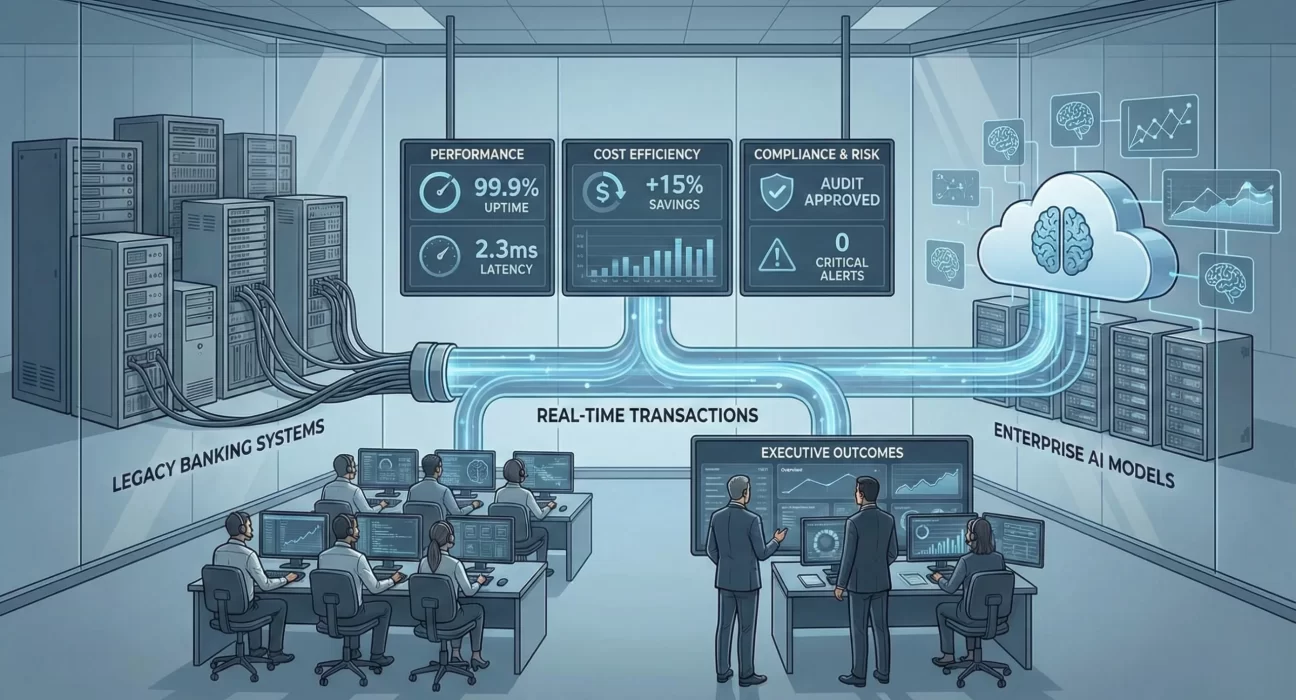
When a mid-sized bank in Mumbai builds an AI model to detect fraudulent transactions, the model itself might work brilliantly in testing. But getting it to run reliably in a production environment that processes lakhs of transactions daily, integrates with core banking systems built fifteen years ago, meets RBI compliance requirements, and doesn’t slow down customer-facing applications is an entirely different challenge.
This is the reality of enterprise software delivery. AI doesn’t exist in isolation. It has to fit into complex, messy, real-world systems that were never designed to accommodate it.
The problems that emerge are rarely about the algorithm. They’re about data pipelines that weren’t built for real-time processing. They’re about infrastructure teams who weren’t consulted early enough. They’re about governance frameworks that don’t have clear approval processes for AI-driven decisions. They’re about operations teams inheriting systems they don’t know how to monitor or troubleshoot.
In large organisations, technology decisions involve multiple stakeholders across business units, IT, legal, compliance, finance, and operations. Each group has legitimate concerns. Each has veto power, formally or informally. Coordinating these groups requires more than technical skill. It requires program management discipline that most technology vendors don’t possess.
The Real Challenges of Scaling AI in Production
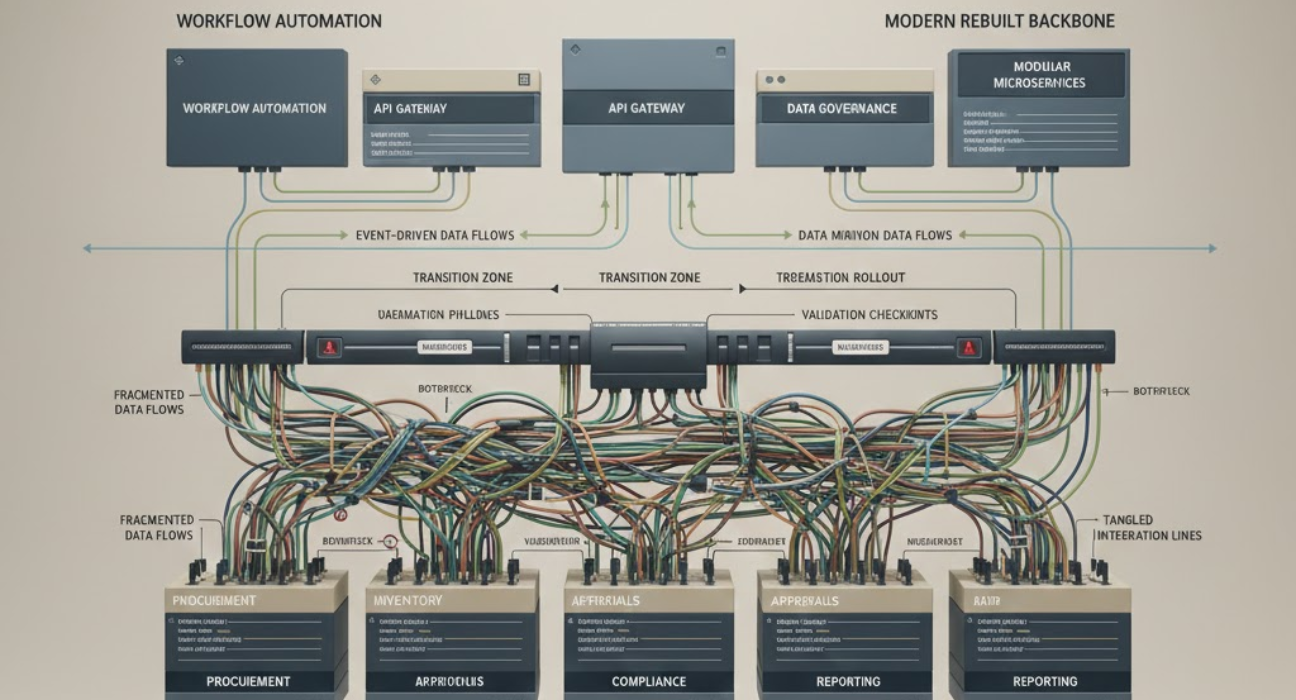
Integration with legacy systems remains the single biggest technical hurdle. Most enterprises run on a combination of modern cloud infrastructure and older on-premise systems that are critical to daily operations. These systems were built with different assumptions, different data formats, different security models. Connecting an AI model to these systems without causing disruption requires deep understanding of both the new technology and the existing architecture.
Data quality and governance become unavoidable once you move beyond pilots. In a proof-of-concept, you can work with cleaned, curated datasets. In production, you’re dealing with data that’s incomplete, inconsistent, stored across multiple systems, and subject to privacy regulations. You need data pipelines that can handle real-world messiness. You need governance processes that define who owns what data, who can access it, and how it can be used.
Performance and reliability matter in ways they don’t during testing. A model that takes thirty seconds to generate a prediction might be acceptable in a demo. In production, if it’s part of a customer-facing application, that thirty seconds is unacceptable. If it crashes once a week, it’s unacceptable. Production systems need to handle peak loads, fail gracefully, recover quickly, and maintain consistent performance under varying conditions.
Monitoring and maintenance are often afterthoughts until something breaks. AI models degrade over time as the patterns in real-world data shift. You need systems to detect when model performance drops. You need processes to retrain and redeploy models. You need people who can diagnose problems quickly when something goes wrong at 2 AM.
Cost management becomes critical at scale. What seemed affordable in a pilot can balloon when you’re processing millions of transactions. Cloud costs, API charges, compute resources, storage, data transfer, all of this needs to be tracked, optimised, and kept within budget. Many enterprises discover too late that their AI system costs far more to run than the value it delivers.
Compliance and risk management can’t be ignored in regulated industries. Banks, insurance companies, healthcare providers, and telecom operators all face strict requirements around data handling, algorithmic transparency, audit trails, and accountability. An AI system that makes decisions affecting customers needs clear documentation of how it works, why it makes specific decisions, and who is accountable when it gets something wrong.
What Separates Successful Programs from Failed Ones
The enterprises that successfully operationalise AI share certain characteristics. They don’t treat it purely as a technology project. They treat it as an enterprise program that requires cross-functional coordination, clear governance, and disciplined execution.
Executive ownership matters more than technical brilliance. Someone at the C-level needs to own the outcome, not just sponsor the initiative. They need to break through organisational silos, resolve conflicts between departments, secure necessary resources, and hold teams accountable for delivery. Without this level of ownership, AI programs drift, timelines slip, and eventually die quietly.
Clear success metrics defined upfront keep programs focused. What does success look like? How will you measure it? When will you know if it’s working? These questions need answers before significant money gets spent. Too many programs start with vague goals about innovation or transformation and end with uncertainty about whether anything was actually achieved.
Realistic timelines based on organisational complexity prevent the frustration that comes from overpromising. Technology vendors love to suggest that everything can be done in three months. Experienced delivery teams know that in a large enterprise, getting approvals, coordinating across teams, integrating with existing systems, and training people takes time. Better to plan for twelve months and deliver in ten than promise six and take eighteen.
Incremental delivery that shows progress builds momentum and confidence. Rather than attempting a big-bang rollout, successful programs deliver value in phases. They start with a limited scope, prove it works, learn from real usage, and expand gradually. This approach reduces risk, allows for course correction, and demonstrates tangible results that justify continued investment.
Strong vendor partnerships that go beyond coding make the difference in complex programs. The best technology partners understand that writing code is only part of the work. They understand enterprise procurement processes, governance requirements, change management, training, documentation, and ongoing support. They stay engaged through the difficult middle phase when initial enthusiasm has worn off and real problems emerge.
This is where partners like Ozrit distinguish themselves. They don’t just build AI models. They help enterprises navigate the entire journey from concept to production, understanding that success depends as much on program execution and stakeholder management as on technical implementation.
The Role of Leadership in Enterprise AI Programs
C-level executives don’t need to understand gradient descent or neural network architectures. But they do need to ask the right questions and ensure the right governance structures are in place.
Is there a clear business case? Not a visionary statement about the future of AI, but specific answers about what problem this solves, how much it costs, what value it delivers, and when that value will be realised.
Who owns this end-to-end? Not who’s excited about it or who suggested it, but who will be held accountable if it fails, who has authority to make decisions when conflicts arise, and who will ensure it gets the attention and resources it needs.
What are the dependencies and risks? What existing systems does this touch? What teams need to be involved? What approvals are required? What could go wrong? What’s the backup plan?
How will we know if it’s working? What metrics matter? How will they be tracked? Who reviews them? What happens if targets aren’t met?
What’s the long-term plan? Who maintains this once it’s built? How do we keep it current? What happens when key people leave? How do we avoid creating technical debt that becomes a problem two years from now?
These aren’t technical questions. They’re leadership questions. And they determine whether an AI initiative becomes a production system that delivers value or another expensive experiment that gets quietly shelved.
Building for Long-Term Sustainability
The true test of enterprise AI isn’t whether it works on launch day. It’s whether it’s still working, still delivering value, and still manageable two years later.
This requires thinking about sustainability from the beginning. It means documenting not just the code but the decisions, the assumptions, the trade-offs. It means building systems that can be understood and maintained by people who weren’t involved in the original development. It means creating operational runbooks that explain how to monitor, troubleshoot, and update the system.
It means investing in training so that internal teams can take ownership over time rather than remaining permanently dependent on external vendors. It means establishing governance processes that define how changes are approved, tested, and deployed. It means setting up monitoring and alerting so problems are detected before customers are affected.
It means honest conversations about total cost of ownership, including ongoing cloud costs, licensing fees, maintenance effort, and eventual replacement or upgrades.
Many enterprises have learned this lesson the hard way, inheriting AI systems that nobody fully understands, that cost more to run than expected, and that become increasingly fragile over time because proper engineering discipline wasn’t applied from the start.
Choosing the Right Execution Partner
The vendor landscape for AI is crowded and confusing. There are pure-play AI specialists who understand algorithms but struggle with enterprise realities. There are large system integrators who understand enterprises but treat AI as just another technology to implement. There are cloud providers who offer platforms and tools but leave the hard work of integration and operations to you.
What’s often missing is a partner who understands both the technology and the organisational complexity of large-scale enterprise delivery. Someone who has managed multi-crore programs with dozens of stakeholders, navigated procurement processes, dealt with legacy systems, handled regulatory requirements, and successfully delivered production systems that actually work.
The right partner doesn’t overpromise. They don’t claim everything is simple or quick. They don’t pretend that technology alone solves organisational problems. They bring program management maturity, realistic planning, transparent communication, and a focus on sustainable delivery.
They understand that enterprise success depends on execution discipline, not just technical capability. They know that managing stakeholders, maintaining momentum through long programs, adapting to changing requirements, and delivering on commitments matters as much as the quality of the code.
What Actually Gets AI to Production
Moving AI models into production requires a combination of technical skill, program management discipline, organisational alignment, and sustained executive attention.
It requires honest assessment of your organisation’s readiness, not just your technical capability but your operational maturity, governance structures, data quality, and willingness to change how you work.
It requires investment not just in technology but in people, processes, training, and ongoing support.
It requires patience to do things properly rather than rushing to meet arbitrary deadlines that were never realistic.
It requires the humility to learn from early mistakes, adjust course when needed, and recognise that production systems are never truly finished but need continuous attention and improvement.
Most importantly, it requires treating AI operationalisation as an enterprise program that deserves the same rigour, governance, and accountability as any major business initiative, because that’s what it is.
The enterprises that understand this, that bring appropriate discipline to AI programs, and that partner with organisations who share this mindset are the ones who will successfully move from innovation theatre to production systems that deliver measurable business value.
The technology is ready. The question is whether your organisation’s execution capability matches your ambition.