

Enterprise executives have spent the past two years being told that AI will transform their businesses. Most of what they’ve seen so far has been chatbots with varying levels of usefulness and proof-of-concept demonstrations that work well in controlled settings but struggle in production environments. The gap between AI’s theoretical potential and its practical application in enterprise operations remains substantial.
The real opportunity with AI in enterprise applications has little to do with conversational interfaces. It’s about embedding intelligence into operational systems to handle work that currently requires human judgment at scale. Contract review that catches problematic clauses before they become legal issues. Exception handling that resolves routine problems without escalation. Data quality monitoring that identifies issues as they occur rather than weeks later when reports don’t reconcile. These aren’t futuristic applications. They’re capabilities that enterprises need right now and that AI can actually deliver when implemented properly.
Where Enterprise AI Actually Creates Value
The challenge with most AI initiatives is that they start with the technology and look for problems to solve. A more productive approach starts with operational problems that are expensive or slow because they require human judgment applied repeatedly at scale. These are the situations where AI can create measurable value if implemented thoughtfully.
Document processing represents one clear opportunity. Large enterprises handle millions of documents that contain information needed for operations, compliance, or decision-making. Invoices that need to be matched to purchase orders and receipts. Contracts that need to be reviewed for specific terms and obligations. Regulatory filings that need to be checked for completeness and accuracy. Human teams do this work today, but it’s expensive, slow, and introduces errors when people get tired or distracted.
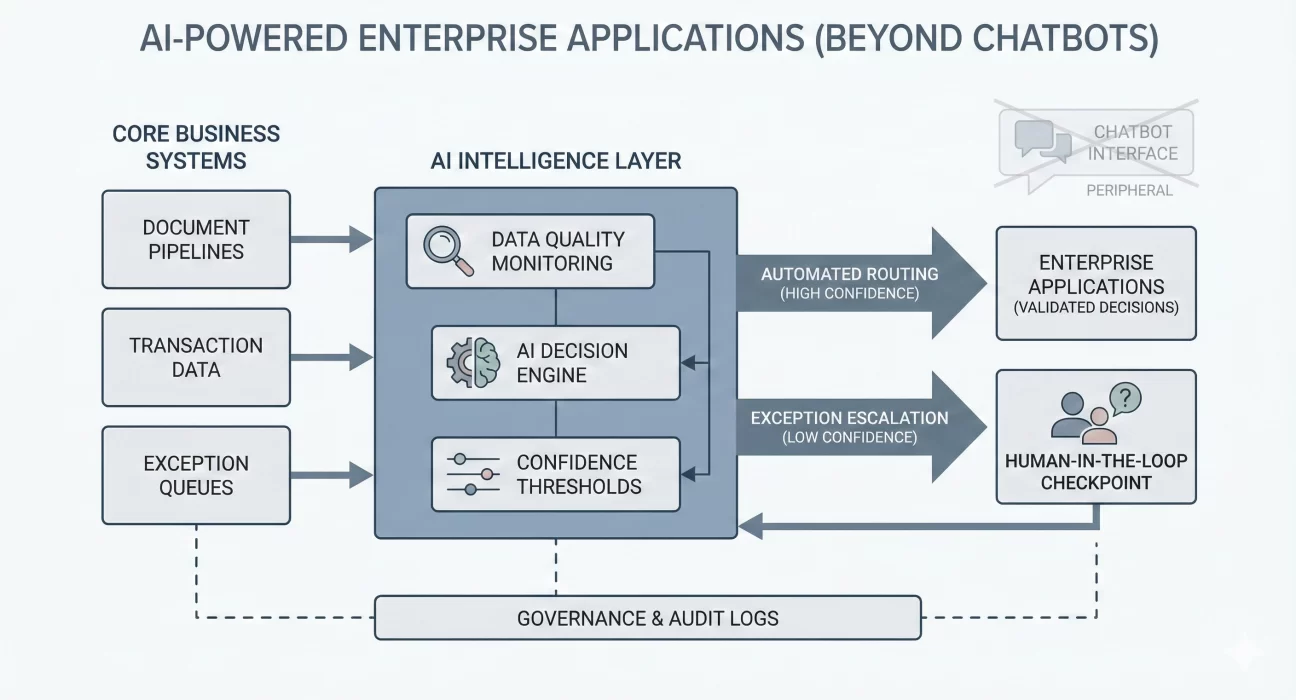
AI-powered document processing can extract structured information from unstructured documents with accuracy that rivals human performance for routine cases. The system handles straightforward documents automatically. Complex or ambiguous cases get flagged for human review. Over time, the system learns from corrections and becomes more accurate. The result isn’t full automation. It’s a significant reduction in the human effort required to process documents at enterprise scale.
Exception handling in operational systems creates similar opportunities. Most enterprise applications generate exceptions when data doesn’t match expected patterns or when processes encounter situations that don’t fit standard rules. These exceptions typically queue for human review. Someone investigates, determines the right resolution, and updates the system. This works, but it’s expensive and introduces delays that affect downstream processes.
Intelligent exception handling can resolve routine exceptions automatically by applying patterns learned from historical resolutions. An order with a minor address discrepancy gets corrected based on customer history. A payment that doesn’t exactly match an invoice gets applied based on context and past behavior. The system handles the straightforward cases and escalates genuinely ambiguous situations to people who can investigate properly. This reduces exception backlogs, speeds up processes, and lets your team focus on problems that actually require human judgment.
The Integration Challenge That Vendors Don’t Mention
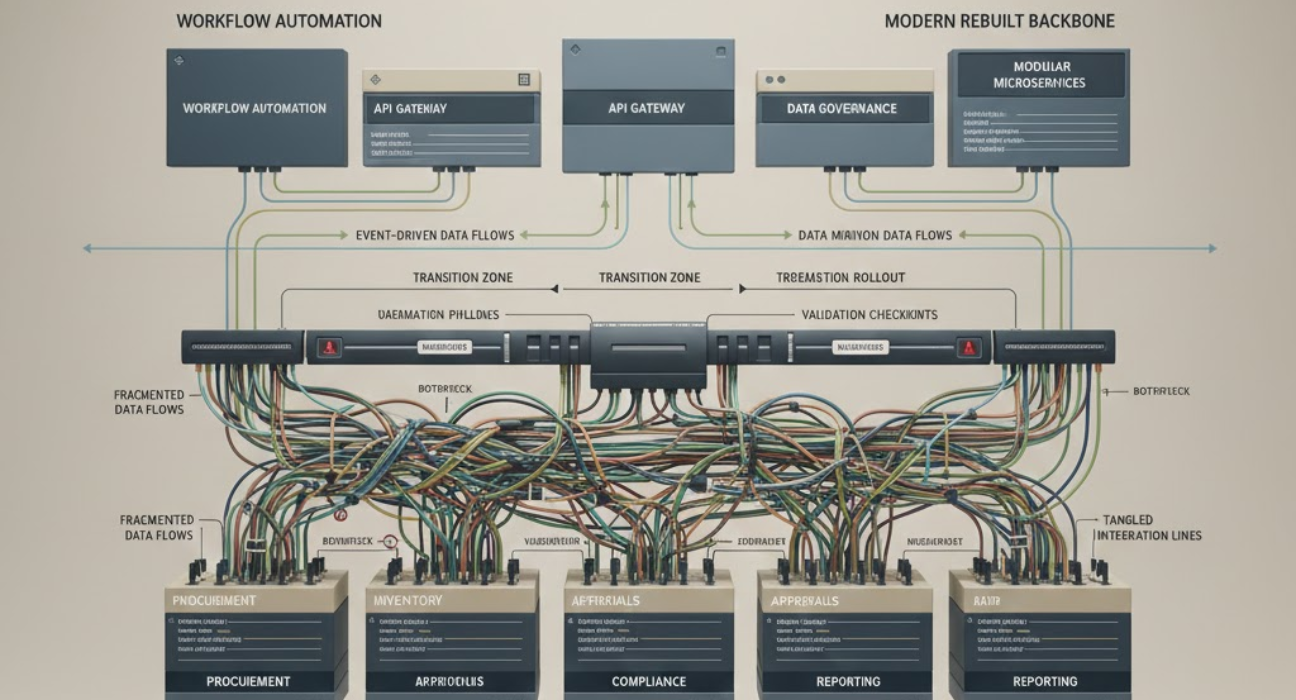
Most AI vendors demonstrate their capabilities using clean data in isolated environments. Production enterprise environments look nothing like these demonstrations. Your data has quality issues accumulated over years. Your systems have integration complexity that spans decades of technology decisions. Your operational requirements include edge cases and exceptions that simple AI models can’t handle.
Making AI work in this environment requires more than deploying a model. It requires building integration layers that connect AI capabilities to your existing systems. It requires data pipelines that prepare information for AI processing while maintaining consistency with your operational data. It requires fallback mechanisms for when AI predictions are uncertain or incorrect. These integration requirements often represent more work than training the AI models themselves.
The governance challenge compounds the integration complexity. AI systems make decisions that affect your operations, your compliance posture, and your customer relationships. You need visibility into why the system made specific decisions. You need controls that prevent AI from taking actions outside acceptable parameters. You need audit trails that satisfy regulatory requirements. Building this governance into AI-powered applications requires understanding both AI technology and enterprise operational requirements.
What Production-Ready AI Applications Actually Require
The gap between an AI proof of concept and a production system is substantial. A proof of concept demonstrates that AI can solve a problem in principle. A production system solves that problem reliably at scale while meeting all your operational, compliance, and integration requirements. Crossing this gap requires different capabilities than most AI vendors provide.
Production AI applications need comprehensive error handling because AI models are probabilistic systems that make mistakes. Your application needs to detect when the AI is uncertain about its predictions. It needs graceful degradation when the AI service is unavailable. It needs mechanisms for humans to review and correct AI decisions. These error handling capabilities need to be built into the application architecture, not added as afterthoughts when problems emerge in production.
Data quality requirements for production AI are significantly higher than for proof-of-concept demonstrations. AI models trained on historical data inherit the biases and errors in that data. Before deploying AI in production, you need to identify and correct data quality issues that would affect model accuracy. You need ongoing monitoring to detect when data patterns change in ways that degrade model performance. You need processes for retraining models as your business evolves.
The operational requirements matter as much as the technical requirements. Your teams need to understand how the AI system works and when to trust its outputs. Your processes need to adapt to incorporate AI capabilities without creating dependencies that fail when AI isn’t available. Your change management procedures need to account for AI model updates that might affect system behavior. Getting these operational elements right takes time and careful coordination with the people who will use and maintain the system.
How Ozrit Builds AI-Powered Enterprise Applications
Ozrit approaches AI-powered enterprise applications by starting with the operational problem rather than the AI technology. We work with enterprises that have identified specific high-value use cases where AI can reduce costs, improve quality, or accelerate processes that currently depend on human judgment at scale.
The team structure for AI-enabled enterprise applications includes both AI specialists and enterprise application engineers. A typical engagement has twenty to twenty-five people combining these capabilities. The AI specialists understand model training, evaluation, and the practical limitations of different AI approaches. The application engineers understand enterprise integration, operational requirements, and how to build reliable systems that work in production environments. Both perspectives are necessary because AI-powered applications fail when either the AI or the integration is inadequate.
Senior team members with experience deploying production AI systems stay involved throughout delivery. They validate that AI model performance meets the accuracy thresholds your operations require. They review integration architecture to ensure the system degrades gracefully when AI predictions are uncertain. They work with your operational teams to design human oversight mechanisms that catch errors before they affect your business. This sustained involvement prevents the common problem where AI works in testing but creates operational issues in production.
Our onboarding process for AI-enabled applications runs four to five weeks. We spend significant time understanding your current operational processes, your data landscape, and the business rules that govern decisions you want AI to support. We also assess data quality and availability because AI model accuracy depends directly on training data quality. If we identify data issues during onboarding, you know about them before development commitments are made rather than discovering them months into the project.
Development timelines for AI-powered enterprise applications typically run fifteen to twenty months. This includes time for data preparation and quality improvement, AI model development and validation, integration with your existing systems, and the operational readiness work needed to deploy AI capabilities into production processes. We also include time for pilot programs that validate AI performance in real operational conditions before full-scale deployment.
After deployment, AI-powered applications require ongoing monitoring and maintenance because model performance can degrade as business conditions change. Our support model includes monitoring that detects performance degradation early and processes for model retraining when needed. The same team that built your application remains available to address issues and enhance capabilities as your requirements evolve.
The Realistic Path to AI Integration
Most enterprises don’t need to become AI companies. They need to incorporate AI capabilities into existing operations where those capabilities create clear value. This means starting with limited scope applications that address specific high-value problems rather than attempting enterprise-wide AI transformation.
A practical approach identifies two or three processes where AI can create measurable impact within twelve to eighteen months. Document processing that reduces manual effort by sixty percent. Exception handling that resolves eighty percent of routine cases automatically. Quality monitoring that catches problems hours instead of days after they occur. These focused applications deliver value while teaching your organisation how to operate AI-powered systems effectively.
Success with initial applications builds the foundation for broader AI integration. Your teams develop understanding of where AI works well and where human judgment remains necessary. Your data quality improves because AI applications create pressure to fix issues that have been tolerated for years. Your operational processes adapt to incorporate AI capabilities naturally rather than treating them as separate systems. This gradual expansion is more likely to succeed than big-bang AI transformation programs that try to change everything simultaneously.
Technology Choices That Support Long-Term AI Operations
AI technology evolves rapidly, but enterprise applications need stability over years of operation. This tension requires careful technology choices that balance current capabilities with long-term supportability. We build AI-powered applications using established frameworks and architectures that are widely supported and well understood by the broader engineering community.
Model architecture decisions prioritise reliability and explainability over achieving the absolute highest accuracy. A model that’s ninety-two percent accurate and can explain its decisions is more valuable in enterprise operations than a model that’s ninety-five percent accurate but operates as a black box. When the AI makes mistakes, you need to understand why so you can correct the issue and improve the model.
The infrastructure approach supports the operational requirements of production AI systems. Models need to respond quickly enough to support real-time operations. They need to scale to handle transaction volumes that vary throughout the day and across business cycles. They need monitoring that detects performance problems before they affect your operations. These infrastructure requirements influence everything from how we deploy models to how we handle model updates.
Building AI Applications That Actually Work
The difference between AI demonstrations and AI applications that create value in production comes down to execution discipline. Understanding where AI can help. Building integration that connects AI to your operations. Designing error handling that maintains reliability when AI is uncertain. Creating oversight mechanisms that catch mistakes before they matter. Getting data quality right. Training your teams effectively. These execution details determine whether AI creates value or creates problems.
Enterprises that succeed with AI don’t chase every new model or capability that emerges. They identify specific operational problems where AI can help, implement solutions that work reliably at scale, and expand gradually as they build capability and confidence. That measured approach might seem less exciting than transformation rhetoric, but it’s what actually delivers value in enterprise environments where reliability and risk management matter more than being first.