

AI Churn Prediction Software: How Field Sales Teams Keep Customers
Most field sales teams learn a customer is leaving when the orders stop. By then the decision was made weeks ago, and the salesperson is left trying to win back an account that has already moved on.
AI churn prediction software reverses that order. It reads the patterns your team already creates (visits, orders, collections, complaints) and flags accounts that look like they are drifting away. Your team gets time to act while the relationship can still be saved.
This guide explains what churn prediction is, which signals matter in field sales, and how to turn predictions into retention actions. It also covers what to look for in a tool.
What Is AI Churn Prediction Software?
AI churn prediction software analyzes customer data to estimate which customers are likely to stop buying, and flags them early enough to intervene.
It compares each account’s recent behavior with patterns seen in customers who left before. The output is usually a risk score or an at-risk list that sales managers can act on.
For field sales teams, this means combining CRM-style data with on-the-ground activity, such as:
- How often reps visit each customer
- Order and collection patterns
- Service issues and complaints
- Customer feedback and satisfaction scores
Churn prediction vs. churn analysis: churn analysis explains why customers left in the past. Churn prediction estimates who is likely to leave next, so you can still change the outcome.
Why Churn Is Harder to Spot in Field Sales
Inside sales teams can watch logins, emails and support tickets. Field sales teams work through visits, distributors, dealers and retailers, and much of that relationship happens offline.
Several things make churn hard to see:
- Visits are hard to verify. If you can’t confirm a visit happened, you can’t tell neglect from a healthy relationship.
- Data lives in too many places. Orders sit in one system, notes in WhatsApp, feedback in a spreadsheet.
- Reps see only their own accounts. No one has the full picture across territories.
- Warning signs are gradual. Order sizes shrink, visits get shorter, and complaints go unresolved. None of it looks urgent on its own.
A prediction model helps because it can weigh many small signals together, which a busy manager rarely has time to do.
Early Warning Signs of Customer Churn
Different businesses have different signals, but most fall into three groups.
| Signal Type | Examples | Why It Matters |
|---|---|---|
| Visit signals | Fewer visits than planned, shorter visits, missed scheduled calls | Neglected accounts drift toward competitors |
| Commercial signals | Declining order size, longer gaps between orders, delayed payments | Shows falling engagement or a switch to another supplier |
| Service and sentiment signals | Repeated complaints, missed SLAs, low satisfaction scores | Unresolved problems are a common reason customers leave |
Visit signals
If a high-value account was visited weekly and is now seen once a month, that gap is a signal. It only shows up if visits are recorded reliably, ideally with proof such as a geofenced check-in.
Commercial signals
Order data is the most direct signal. A steady customer who orders every ten days and then goes quiet for a month deserves a call.
Service and sentiment signals
Customers rarely leave without warning. They complain first. Tracking response times against your service commitments and capturing feedback after visits gives the model early evidence of dissatisfaction.
How AI Churn Prediction Works
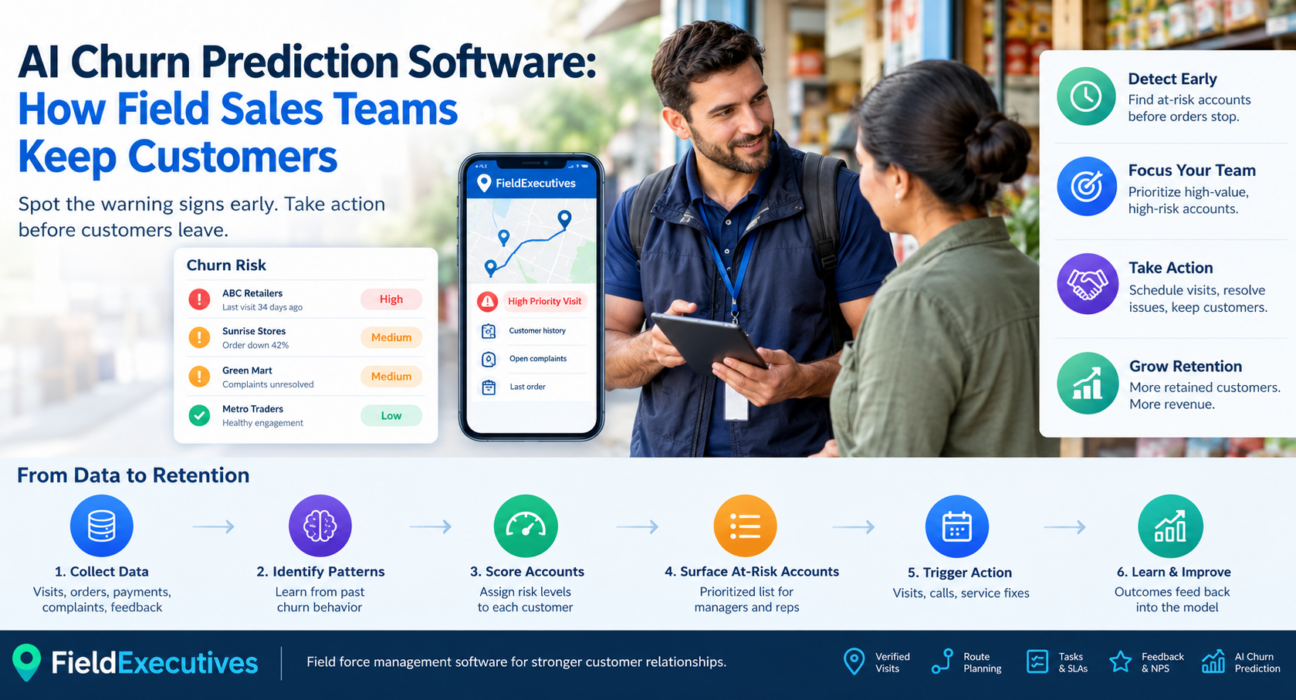
The details vary by product, but the process usually follows these steps:
- Collect data. The system pulls in visit history, orders, payments, feedback and service records.
- Identify patterns. It learns what the behavior of customers who churned looked like in the months before they left.
- Score current customers. Each account is compared against those patterns and given a risk level.
- Surface at-risk accounts. Managers and reps see a prioritized list instead of raw data.
- Trigger action. Teams assign follow-up visits, calls or service fixes.
- Learn from outcomes. Whether an account stays or leaves feeds back into future predictions.
The quality of the prediction depends on the quality of the data. If visits and orders aren’t captured consistently, the score will be unreliable.
How Field Sales Teams Can Act on Churn Predictions
A risk score is only useful if it changes what people do next. A simple retention playbook helps:
- Rank by value and risk. Focus first on accounts that are both high-value and high-risk.
- Assign an owner and a deadline. Every flagged account gets a named rep and a date for the next touchpoint.
- Schedule a targeted visit. Add the visit to the rep’s route so it happens this week, not “when there’s time.”
- Arrive with context. Give the rep the recent order history, open complaints and last visit notes.
- Fix the root cause. If the issue is delivery delays or pricing, escalate it internally rather than just repeating the sales pitch.
- Log the outcome. Record what was discussed and decided so the next prediction cycle has better data.
What to say in a retention visit
- Ask open questions about what has changed in their business.
- Acknowledge unresolved problems and give a specific resolution date.
- Avoid leading with discounts. Price is not always the reason for churn, and discounting habitually erodes margin.
Manual Tracking vs. AI Churn Prediction
| Factor | Manual / Spreadsheet Tracking | AI Churn Prediction |
|---|---|---|
| Detection speed | After orders drop | Before orders drop |
| Signals considered | A few, chosen by the manager | Many signals, weighed together |
| Scale | Breaks down as accounts grow | Handles large account lists |
| Prioritization | Based on memory and judgment | Ranked by risk |
| Consistency | Varies by manager | Same method for every account |
AI does not replace a good account manager. It points that manager to the accounts that need attention most.
What to Look for in AI Churn Prediction Software
Not every tool suits field sales. When comparing options, check for:
- Field activity data. The tool should capture verified visits, not just CRM entries.
- Unified data. Visits, tasks, orders, collections and feedback should live in one place.
- Clear risk scores. Managers should be able to see why an account was flagged, not just that it was.
- Workflow integration. Predictions should lead directly to tasks and visits.
- Mobile, offline-capable apps. Reps in low-connectivity areas still need to log data.
- Reporting. You should be able to track retention outcomes over time.
- Ease of setup. A tool nobody adopts won’t produce useful predictions.
How FieldExecutives Supports Customer Retention
Churn prediction depends on reliable field data, which is where many teams fall short. Businesses looking to simplify these processes can use field force management software such as FieldExecutives.
FieldExecutives brings the day-to-day field workflow into one platform:
- Verified visits. Geofenced attendance and proof of visit capture (photo, signature, OTP) give you an accurate record of customer contact.
- Route and beat planning. AI-assisted planning makes it easier to fit priority visits into a rep’s day.
- Task and SLA management. Assign follow-ups and track service commitments against deadlines.
- Feedback and NPS. Capture customer sentiment as part of the visit workflow.
- Collections and expenses. Track payments through to settlement.
- Real-time KPIs and reports. Managers get live visibility of team activity and results.
- AI lead scoring and churn prediction. Turn this activity data into risk signals for at-risk accounts.
Because these data points sit in one system, managers can move from “this account looks quiet” to “assign a visit this week” without switching tools.
Best Practices for Reducing Churn in Field Sales
- Record every visit. Predictions are only as good as the visit data behind them.
- Set a visit cadence by account tier. Then track adherence, not just totals.
- Respond to complaints within a defined SLA. Slow resolution is a common trigger for churn.
- Review at-risk accounts weekly. Make it a fixed agenda item in sales reviews.
- Coach, don’t blame. A churn flag is a prompt to help the rep, not to penalize them.
- Measure retention. Track how many flagged accounts you retained, and refine your approach.
Conclusion
Customers seldom leave suddenly. They show signs first: fewer orders, unanswered complaints, missed visits. AI churn prediction software helps field sales teams read those signs early, prioritize the right accounts and use rep time where it protects the most revenue.
The technology works best on a foundation of accurate field data and a clear process for acting on the results. Start by capturing visits and customer feedback reliably, then build a weekly routine around your at-risk list.
If you want that foundation in one platform, explore how FieldExecutives can help you track field activity and act sooner on at-risk customers.