


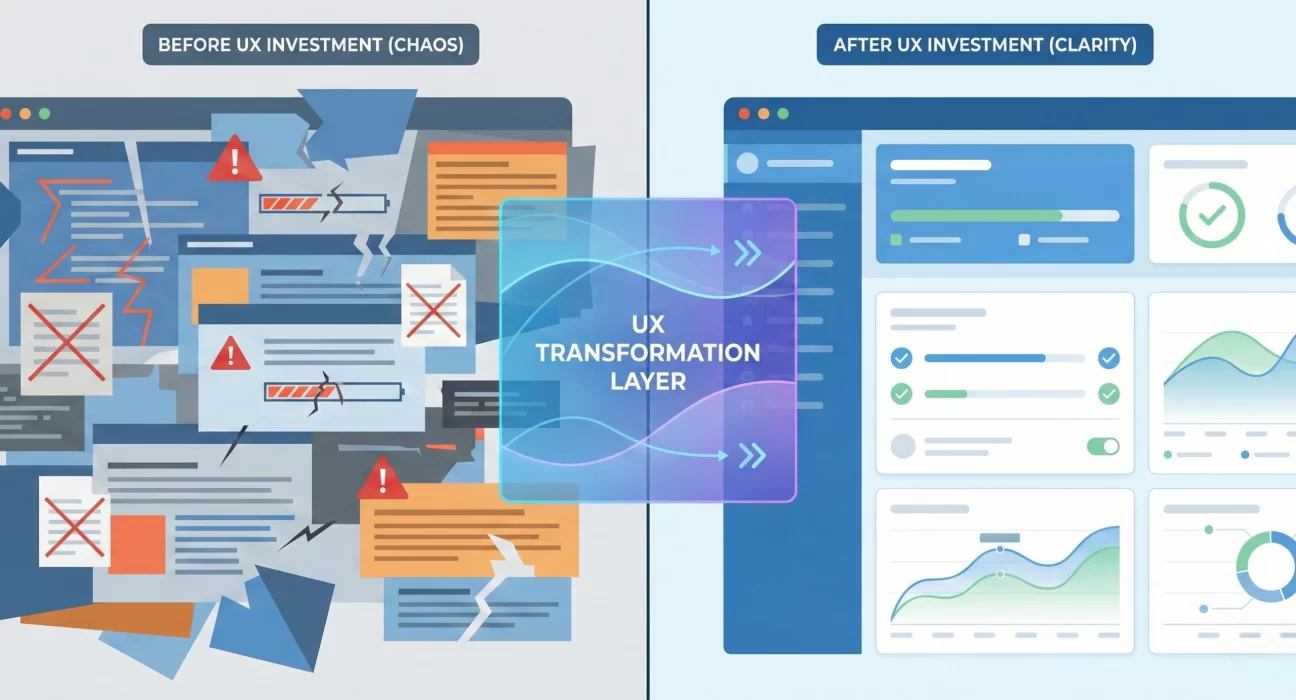
Most enterprise technology projects don’t fail because of bad code. They fail because nobody wants to use what gets built.
I’ve watched this happen across organisations large banks, insurance companies, manufacturing groups, government departments. Millions spent. Years invested. A system goes live. And then the real problem starts: people find workarounds. They keep using spreadsheets. They call IT support constantly. Adoption stalls. The business case that justified the investment quietly falls apart.
The conversation in most boardrooms still centres on infrastructure, security, integration, and timelines. These matter. But there’s a less visible factor that determines whether your enterprise system becomes a strategic asset or an expensive liability: user experience design.
This isn’t about making things pretty. It’s about whether your investment actually delivers the business outcomes you committed to.
Why UX becomes critical at enterprise scale
In a small company, if software is confusing, someone walks over to IT and asks for help. In an enterprise with 5,000 employees across 12 locations, that same confusion gets multiplied into thousands of support tickets, training delays, and productivity losses.
The stakes are different at scale. When a procurement system is difficult to navigate, purchasing decisions slow down. When a customer service portal is poorly designed, your agents take longer per call and customer satisfaction drops. When an internal approval system has too many steps, important decisions get delayed.
These aren’t minor inconveniences. They show up in your P&L as higher operational costs, longer cycle times, and missed revenue targets.
I’ve seen a leading BFSI organisation roll out a loan origination system that was technically sound but practically unusable. Branch staff couldn’t complete applications without calling the helpdesk. What should have taken 15 minutes was taking 45. Customer drop-off rates increased. Six months later, they had to spend additional budget redesigning the interface not because the system was broken, but because nobody had thought carefully about how real people would use it under real working conditions.
The hidden costs of poor UX in enterprise systems
Let me be specific about what poor UX actually costs.
Training and onboarding costs multiply. When systems are unintuitive, you need longer training programs, more detailed documentation, refresher sessions, and dedicated support staff. For a company with high employee turnover or seasonal hiring, this becomes a recurring expense.
Productivity losses compound daily. If your sales team spends an extra 10 minutes per transaction because the CRM is clunky, that’s lost selling time. Multiply that across hundreds of users and thousands of transactions. It adds up to real revenue impact.
Error rates increase. Confusing interfaces lead to mistakes. In healthcare, this can be dangerous. In finance, it can be expensive. In manufacturing, it disrupts operations. The cost isn’t just fixing the errors it’s the downstream impact on customers, compliance, and reputation.
Adoption resistance creates shadow IT. When official systems are too difficult, people create workarounds. They use personal tools, spreadsheets, and shared drives. This fragments your data, creates security risks, and undermines the entire purpose of your enterprise investment.
Change management becomes harder. Every time you want to roll out an update or a new feature, you face resistance because users associate your systems with frustration. What should be continuous improvement becomes a battle.
These costs rarely appear in the original business case. But they’re very real. And they persist for the entire lifecycle of the system often 7 to 10 years or more in enterprise environments.
What actually drives ROI in enterprise UX
The return on UX investment isn’t abstract. It shows up in measurable business metrics.
Faster time-to-value. Well-designed systems require less training and support. New employees become productive faster. When you’re hiring 200 people for a new delivery centre, this matters. The difference between two weeks of training versus four weeks is material in cost, in ramp-up time, and in business readiness.
Higher adoption rates. Systems that work the way people think get used. This sounds obvious, but it’s rare. When adoption rates improve, you actually realise the benefits that justified the investment in the first place. The system becomes part of how work gets done, not something people avoid.
Lower support costs. Intuitive design reduces the volume of helpdesk tickets. Support teams can focus on genuine technical issues rather than explaining how to complete basic tasks. For large organisations, this can mean the difference between a support team of 10 versus 30 people.
Improved compliance and audit readiness. When processes are built into the UX clearly, people follow them. This reduces compliance violations, makes audits smoother, and lowers regulatory risk. In heavily regulated industries, this alone can justify the UX investment.
Better data quality. Good UX includes validation, helpful prompts, and clear workflows. This means cleaner data entering your systems. Better data means better decisions, better reporting, and better automation. Poor data quality costs enterprises millions in manual cleanup, in wrong decisions, in lost opportunities.
Competitive advantage in talent. People want to work with modern, well-designed tools. When your internal systems feel like they’re from 2005, it affects employee satisfaction and retention. This matters in competitive talent markets, especially for technology and business roles.
The ROI case for UX isn’t theoretical. I’ve seen organisations measure it. One retail company redesigned their store operations platform and tracked a 35% reduction in transaction time. A logistics provider improved their driver app and saw fuel efficiency gains because drivers could navigate routes more effectively. A bank redesigned their loan processing system and cut processing time by half which meant they could handle more volume with the same team.
Why UX fails in most enterprise projects
If the case for UX is clear, why do so many enterprise projects still get it wrong?
UX gets deprioritised under budget pressure. When projects run into cost overruns and they usually do UX is treated as optional. “Let’s get it working first, we’ll improve the interface later.” Later never comes. Or it comes as a costly redesign after go-live when everyone’s frustrated.
Requirements are gathered from management, not users. Business analysts talk to department heads who describe what the system should do. But the people who will actually use the system every day aren’t in the room. The result is a system that looks good in presentations but doesn’t match how work actually flows.
Technical teams drive the design. Developers are brilliant at building systems. But they’re not representative users. What seems logical to someone who understands databases and APIs can be baffling to a branch operations officer or a customer service agent. Without dedicated UX expertise, you get engineer-designed interfaces functional but not usable.
Legacy constraints dominate. Many enterprise projects involve integrating with or replacing legacy systems. The old system’s logic and structure get carried forward into the new interface. You end up with modern technology wrapped around 20-year-old workflows. This is a missed opportunity to rethink how work should actually happen.
No one owns the user experience. In large projects, you have a project manager, a technical lead, a business sponsor. But who owns whether the system is actually easy to use? Often, no one. It falls through the cracks between business and IT.
Testing focuses on functionality, not usability. QA teams check whether features work as specified. They don’t check whether users can actually figure out how to use those features under real working conditions. Usability testing with actual end users is rare in enterprise projects.
These are execution failures, not technology failures. They’re about how enterprise programs are structured, governed, and delivered.
What good UX delivery looks like in enterprise programs
Successful enterprise UX isn’t about hiring a designer to make screens look nice. It’s about embedding user-centred thinking into the entire delivery process.
Start with user research, not requirements documents. Before you design anything, understand who will use the system, what they’re trying to accomplish, what their constraints are, and what their current pain points are. This means spending time with actual users—observing them, talking to them, understanding their context. Not in a conference room. At their desks, in branches, on factory floors, wherever they work.
Create realistic user personas and journeys. Not generic marketing personas. Detailed profiles based on research—what tools they use, what their day looks like, what pressures they’re under, what success looks like for them. Map their actual workflows, not idealised process diagrams. This becomes the foundation for design decisions.
Design iteratively with user feedback. Build prototypes before you build software. Test them with real users. Watch where they get confused. Listen to their questions. Refine. Repeat. This is far cheaper than discovering usability problems after code is written. And it catches assumptions before they become expensive mistakes.
Maintain design consistency at scale. In large systems with multiple modules built by different teams, consistency matters. Users shouldn’t have to learn different interaction patterns for each module. This requires design systems, component libraries, and governance. It requires someone ensuring that the procurement module and the HR module feel like parts of the same system.
Involve UX throughout delivery, not just upfront. UX isn’t a phase that ends when development starts. As technical constraints emerge, as requirements change, as integrations prove complex UX needs to be at the table, ensuring that solutions remain user-centred. The best UX professionals I’ve worked with sit with developers, participate in sprint reviews, and help solve problems in real time.
Test with real users in real conditions. Before go-live, conduct usability testing. Not with friendly IT staff. With actual end users who represent your user base. Give them realistic scenarios. Watch them work. Measure task completion rates, error rates, time on task. Fix critical issues before launch. Plan for improvements after launch based on feedback.
Plan for adoption, not just deployment. Launching the system is not a success. Success is when people are using it effectively. This requires change management, training tailored to different user groups, ongoing support, and listening channels. Plan for this from the beginning, not as an afterthought.
This level of rigour is uncommon in enterprise programs. It requires discipline, expertise, and executive support. But it’s the difference between systems that deliver ROI and systems that become expensive regrets.
The role of the right execution partner
Most CXOs I speak with are frustrated by the gap between what vendors promise and what gets delivered. Technology partnerships often feel transactional contracts signed, teams deployed, features shipped. But the quality of execution, the depth of thinking, the ability to navigate enterprise complexity these vary enormously.
UX-centred delivery requires a partner who genuinely understands enterprise realities. Someone who has managed large-scale programs. Who knows that business users don’t think like technologists. Who can balance innovation with governance, speed with quality, modern practices with legacy constraints.
At Ozrit, we’ve built our approach around exactly these realities. We don’t treat UX as a separate workstream. It’s integrated into how we understand requirements, how we architect solutions, how we build and test, and how we support adoption. Our teams include UX researchers and designers who work alongside business analysts and developers from discovery through delivery and beyond.
This matters in enterprise contexts. When you’re modernising a core banking system or transforming supply chain operations or building a customer portal that serves millions, you can’t retrofit good UX at the end. It has to be foundational. And that requires a delivery partner whose DNA includes user-centred thinking, not just technical capability.
Making the business case to your board
If you’re a CXO looking to prioritise UX in your next enterprise initiative, you’ll need to make a clear business case.
Frame it in business outcomes, not features. Don’t talk about “better interfaces.” Talk about reduced training costs, faster onboarding, higher productivity, better data quality, lower support burden. Quantify where you can. Use benchmarks from comparable organisations or from your own past projects.
Highlight risk mitigation. Poor UX leads to low adoption, which means project ROI doesn’t materialise. This is a material risk. Frame UX investment as risk reduction ensuring that the business benefits you’ve committed to the board actually get realised.
Show the cost of poor UX from previous projects. If you’ve launched systems that struggled with adoption or required expensive redesigns, use those as evidence. Most enterprises have these examples. They’re powerful because they’re real, not hypothetical.
Position UX as a competitive advantage. In sectors where customer experience matters, internal systems directly affect how well your teams can serve customers. Better tools for your people translate to better outcomes for your customers. In industries competing for talent, modern systems become a retention and recruitment advantage.
Allocate the budget explicitly. Don’t bury UX costs in development estimates. Make it a clear line item. This signals importance and ensures it doesn’t get deprioritised when budgets tighten. A typical enterprise program should allocate 10-15% of budget to UX research, design, and testing. This isn’t overhead, it’s an investment that pays back many times over.
Establish success metrics upfront. Define how you’ll measure UX success. Task completion time, error rates, support ticket volume, training duration, user satisfaction scores, adoption rates. Build these into your project governance. Track them. Report them. Make them visible to leadership.
The business case for UX isn’t hard to make once you focus on tangible outcomes rather than aesthetic improvements.
What the best enterprise leaders actually do
The most effective CXOs I’ve observed don’t just approve UX budgets. They create conditions for UX-centred delivery to succeed.
They ask different questions. Not just “when will it be ready” but “have we tested this with actual users?” Not just “does it meet requirements” but “will people actually use it?” This signals to the entire project team that usability matters.
They ensure user representation. They make sure end users are involved not just consulted once, but continuously engaged throughout the program. They protect time for user research and testing, even when timelines are tight.
They hold teams accountable for adoption, not just delivery. Success isn’t measured by go-live dates. It’s measured by whether users adopt the system and whether business outcomes improve. This changes how teams think about their work.
They invest in building internal UX capability. Not just hiring designers, but building organisational understanding of why UX matters and how to do it well. This means training, shared language, and making UX part of how the organisation approaches all technology initiatives.
They choose partners based on delivery maturity, not just cost. The cheapest vendor rarely delivers the best outcome. They look for partners who demonstrate understanding of enterprise complexity, who have proven UX capability, who take ownership of outcomes, not just deliverables.
This isn’t about being involved in design decisions. It’s about creating the right governance, asking the right questions, and ensuring that the organisation takes user experience as seriously as security or performance.
The path forward
If you’re leading a major technology initiative whether it’s core system replacement, digital transformation, customer portal development, or internal tool modernisation—you have a choice.
You can continue the traditional approach: focus on technical requirements, functional specifications, and delivery timelines. Treat UX as cosmetic. I hope that users will adapt. Then deal with the consequences of low adoption, high support costs, frustrated users, unrealised benefits.
Or you can make UX central to how you plan, deliver, and measure success. This requires allocating budget, bringing in the right expertise, involving users, and partnering with people who genuinely understand enterprise delivery.
The ROI case is clear. Better UX drives faster adoption, higher productivity, lower costs, and better business outcomes. It reduces program risk and increases the likelihood that your investment delivers what you promised your board.
The question isn’t whether UX matters. The question is whether your organisation is mature enough to prioritise it even when budgets are tight, timelines are aggressive, and legacy constraints are real.
The enterprises that get this right don’t just build better systems. They build capability that compounds over time. Every initiative becomes easier because users trust that new systems will work well. Change management becomes smoother. Technology becomes an enabler rather than a barrier.
That’s the real ROI of investing in UX. Not just better interfaces. Better business outcomes, delivered more reliably, with less friction and waste.
If your current approach isn’t delivering these results, it might be time to rethink how you’re executing enterprise programs. Technology has never been better. The methodologies are proven. What’s often missing is the discipline to put users at the centre not as a principle you agree with in theory, but as a practice you follow rigorously throughout delivery.
That’s the conversation worth having in your next leadership meeting.