

A large retail chain invested heavily in a custom AI model to optimize inventory across 200 stores. The data science team delivered impressive results; the model predicted demand with 91% accuracy during testing, promising to reduce stockouts by 40% and cut excess inventory by 25%.
Eighteen months later, the CFO asked a simple question during a quarterly review: “Are we actually seeing these benefits?”
The answer was uncomfortable. Store managers had stopped trusting the model’s recommendations six months ago. Accuracy had dropped to 71%. The system was suggesting stock levels that didn’t match ground reality. Nobody had noticed because the metrics being tracked were technical model uptime, processing speed, API response times not business outcomes.
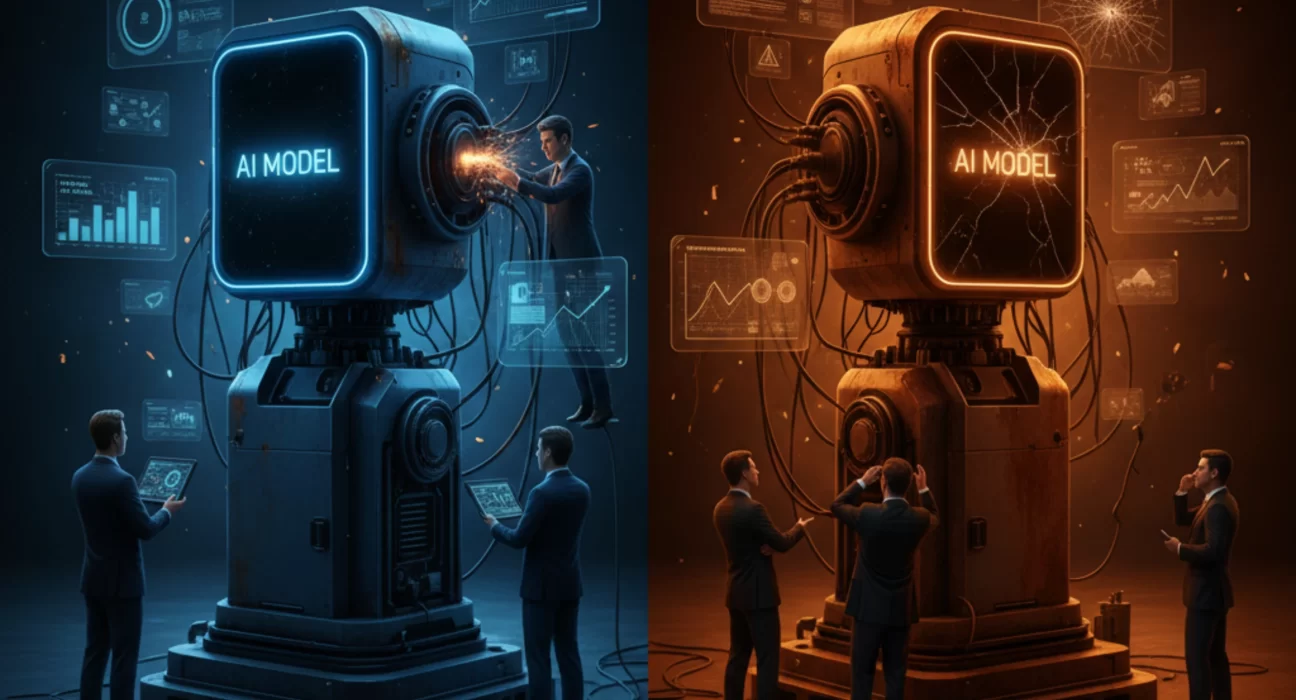
The model hadn’t failed catastrophically. It had degraded quietly, like a machine running without maintenance. By the time leadership asked questions, the team that built it had moved on to other projects, the assumptions underlying the model no longer matched business reality, and fixing it would cost almost as much as building it from scratch.
This pattern repeats across enterprises worldwide. Custom AI models are built with great effort and expense, work reasonably well initially, then slowly become less useful until they’re either ignored or require expensive overhauls.
The question isn’t whether you can build a good AI model. The question is whether you can build one that continues improving or at least maintaining its value as your business evolves.
The Uncomfortable Truth About AI Model Lifecycles
Most executives think about AI models the way they think about traditional software. You define requirements, build the system, test it, deploy it, and then maintain it with occasional updates.
AI models don’t work that way.
Traditional software has stable logic. If your accounting system calculates taxes correctly today, it will calculate them correctly next month unless you change the code or the tax laws change. The behavior is deterministic and predictable.
AI models learn patterns from data. Those patterns reflect the world as it existed when the training data was collected. When the world changes and it always does the patterns become less relevant, and the model’s predictions become less accurate.
Customer behavior shifts. Market dynamics evolve. Competitors introduce new offerings. Regulations get updated. Internal processes change. New products get launched. Supply chains get reorganized.
Each change affects the statistical relationships your model relies on. A model predicting customer churn based on 2022 behavior may struggle with 2024 customers who have different expectations, preferences, and alternatives. A fraud detection model trained on pre-digital payment methods becomes less effective as payment technologies evolve.
The degradation is often invisible until it causes significant problems. Unlike a crashed server or a broken integration that triggers immediate alerts, model accuracy degrading from 89% to 82% happens gradually. Each individual prediction still looks reasonable. The overall decline only becomes apparent when someone systematically measures performance against ground truth which many organizations don’t do consistently.
The knowledge loss compounds the problem. In most enterprises, the data scientists who built the initial model move to other projects or leave the company within 18-24 months. The documentation they left behind explains what the model does but not why certain design choices were made, what assumptions exist, or what scenarios it handles poorly. When performance issues emerge, the people investigating don’t have the context to understand root causes.
The infrastructure gaps become evident. Most model development focuses on achieving good accuracy during training and testing. Far less attention goes to building systems for monitoring production performance, collecting feedback data, retraining models efficiently, and deploying updates safely. These operational capabilities are assumed to be simple add-ons but turn out to be complex challenges requiring significant engineering investment.
What Separates Models That Improve from Those That Decay
After observing dozens of enterprise AI implementations, clear patterns emerge separating successful long-term deployments from those that struggle.
The successful ones treat model development as the beginning of a journey, not the end. Deployment marks the transition from building to operating and improving. The real work monitoring, learning, and evolving happens after launch.
They build integrated teams that own models end-to-end. The people who understand why the model makes certain predictions are involved in monitoring production performance, investigating anomalies, and implementing improvements. There’s no handoff from data scientists to engineers to business operations where context and accountability get lost.
They design for maintainability from day one. A model that’s 3% more accurate but impossible to understand, debug, or update delivers less long-term value than a simpler model that performs well enough and can be easily maintained and improved. This trade-off gets ignored in the rush to maximize initial performance metrics.
They invest as much in operational infrastructure as in model development. Systems for monitoring performance, collecting feedback, retraining efficiently, and deploying updates safely aren’t afterthoughts; they’re designed and built alongside the model itself.
They set realistic expectations about ongoing costs. Building and deploying a model might cost 100 rupees. Maintaining, monitoring, and improving it will cost 30-50 rupees annually. Organizations that don’t budget for this ongoing investment watch their models deteriorate.
Most importantly, they measure what actually matters for business outcomes, not just technical metrics. Model accuracy is interesting, but what matters is whether the business decisions influenced by the model are improving measurably.
Building Monitoring That Actually Works
The foundation of continuous model improvement is knowing when performance degrades. This sounds simple but proves difficult in practice.
Technical monitoring is necessary but insufficient. You need to track whether the model is running, responding to requests, and processing data correctly. But these metrics tell you the system is functioning, not whether it’s making good predictions.
A fraud detection model might be up 99.9% of the time with millisecond response latencies while completely missing new fraud patterns that emerged last month. The technical dashboards show green, but the business is losing money.
Performance monitoring needs to track business-relevant metrics. For a demand forecasting model, this means comparing predictions against actual sales, calculating forecast error rates, and measuring inventory optimization results. For a customer churn model, it means tracking how many predicted churners actually leave and how many who leave weren’t predicted.
These metrics need regular calculation and clear ownership. Someone needs to be accountable for reviewing them weekly or monthly, investigating anomalies, and escalating issues.
Segmented monitoring reveals hidden problems. Overall model accuracy might look fine while performance for specific customer segments, product categories, or geographic regions has degraded significantly. You need to slice performance metrics by relevant dimensions to catch these patterns.
A pricing optimization model might maintain good average performance while producing problematic recommendations for newly launched products or in markets where competitive dynamics have shifted. Without segmented monitoring, these issues remain invisible until they cause visible business problems.
Alerting thresholds require careful calibration. Set them too sensitive and you generate alert fatigue where people ignore notifications. Set them too loose and you miss significant degradation until it’s obvious in business results.
Finding the right balance requires understanding normal performance variation versus meaningful drift. This often needs iterative tuning based on experience with the specific model and business context.
The enterprises succeeding with AI at scale invest in building robust monitoring infrastructure early. This isn’t glamorous work compared to developing cutting-edge models, but it’s what separates systems that improve over time from those that gradually fail.
Creating Feedback Loops That Drive Improvement
Models improve by learning from experience. This requires systematic collection of feedback about prediction quality.
For some applications, feedback arrives naturally. A sales forecast model gets validated when actual sales data is recorded at the end of each period. A customer churn prediction gets confirmed or refuted based on whether the customer actually leaves. This feedback can be automatically collected and used for model improvement.
For others, you need to engineer feedback mechanisms. A loan approval model’s decisions need outcomes tracked over time: did approved customers repay, did rejected customers go elsewhere and prove creditworthy? A content moderation model needs human review to validate decisions, but reviewing every decision is impractical.
Smart sampling strategies help manage costs while ensuring useful feedback. Review a random sample for baseline accuracy. Over-sample cases where the model had low confidence. Review all cases in important but rare categories. Track outcomes for all high-stakes decisions.
The feedback needs context, not just correctness. Knowing the model was wrong is useful. Understanding why it was wrong, what factors it missed, what assumptions failed, what patterns in the data were misleading is more valuable for driving improvements.
This requires mechanisms for subject matter experts to provide qualitative feedback alongside quantitative performance data. When a product manager sees a demand forecast that’s clearly wrong, they should be able to explain what the model missed, perhaps a competitor launched a similar product, or there was a supply chain disruption, or a marketing campaign had unexpected impact.
The feedback loop must close. Collecting feedback data that never gets analyzed or incorporated into model improvements wastes everyone’s time and breeds cynicism. There need to be clear processes for reviewing feedback, identifying patterns, and translating insights into model enhancements.
Many organizations build elaborate feedback collection systems that generate volumes of data nobody actually uses. The feedback sits in databases while models continue making the same mistakes. Closing this loop requires both technical infrastructure and organizational process.
Managing Model Updates and Versioning
Improving models means deploying updates. But model updates carry risks that need systematic management.
Validation rigor must match initial deployment standards. A retrained model might show better overall accuracy while performing worse for important customer segments. It might optimize for the wrong metric. It might behave unexpectedly in edge cases the training data didn’t represent well.
Before deploying updates to production, you need comprehensive validation. This includes technical testing: does the code work correctly, does it integrate properly with existing systems and business validation, does the improved accuracy translate to better business outcomes, are there any segments where performance degrades?
A/B testing provides confidence in production environments. Rather than switching all traffic to an updated model immediately, gradually shift a percentage of decisions to the new version while monitoring comparative performance. If the new model performs better across key metrics over a meaningful time period, complete the migration. If it underperforms or shows unexpected behavior, roll back quickly.
This staged rollout approach catches problems that testing environments miss because production data patterns are subtly different from training and test data.
Version control and rollback capability are essential. When an updated model causes problems, you need to quickly revert to the previous version while investigating. This requires maintaining model versions, deployment configurations, and the ability to switch between them without disrupting service.
Many organizations deploy model updates the same way they deploy code, replace the old version with the new version and hope nothing breaks. When something does break, recovery is difficult and slow.
Documentation of changes matters for institutional knowledge. Each model update should include clear documentation: what changed, why the change was made, what improvements were expected, what validation was performed, and what known limitations exist. This creates an audit trail that helps future teams understand the model’s evolution.
Without this, you end up with models that have gone through multiple updates but nobody fully understands how they work or why specific design choices were made.
Designing Training Processes That Scale
Model improvement depends on efficient retraining processes. Manual retraining—where data scientists manually collect data, prepare it, train a new model, and validate results—doesn’t scale when you have dozens or hundreds of models in production.
Automated training pipelines turn feedback into improvement systematically. Once new training data meets quality and volume thresholds, the pipeline automatically triggers model retraining, runs validation tests, and prepares the new model for deployment review.
This automation requires thoughtful design. How do you combine new data with historical data without letting recent observations dominate? How do you validate that the retrained model is actually better across all relevant dimensions? How do you handle cases where retraining makes performance worse?
Data preparation consistency proves critical. The same data cleaning, feature engineering, and preprocessing steps used during initial training need to be applied to new data. Inconsistencies in how data is prepared create subtle bugs that degrade model quality.
This requires treating data preparation as code versioned, tested, and applied consistently rather than manual steps that might vary between training runs.
Training frequency needs to match the rate of change in your environment. Some models need retraining weekly as patterns shift rapidly. Others might only need quarterly or annual updates. The right frequency depends on monitoring what happens to model performance over time without retraining.
Too frequent retraining wastes resources and risks introducing instability. Too infrequent retraining allows models to drift away from current reality.
Resource management becomes important as model portfolios grow. Training large models consumes significant computational resources. Running dozens of training jobs simultaneously can overwhelm infrastructure and drive up costs.
You need orchestration systems that schedule training jobs efficiently, allocate resources appropriately, and provide visibility into training status and results.
Enterprise delivery partners with experience in complex IT programs, such as Ozrit, understand that these operational challenges often determine long-term success more than the sophistication of the underlying algorithms. Building robust, maintainable training infrastructure requires program management maturity, not just data science expertise.
Handling Data Quality and Availability
Models are only as good as the data they learn from. Maintaining and improving data quality over time determines whether continuous improvement is possible.
Training data freshness naturally decays. Historical patterns become less representative of current conditions. You need processes to identify when training data is becoming stale and strategies for refreshing it appropriately.
This gets complicated when the environment changes substantially. During major disruptions economic shifts, regulatory changes, technology transitions historical data may become actively misleading rather than just less relevant. Deciding how much weight to give recent versus historical data requires business judgment combined with technical experimentation.
Data pipeline reliability determines whether you can actually execute retraining. If the automated processes collecting training data break and nobody notices for months, that training opportunity is lost. Many data flows are designed for immediate operational use but don’t systematically store data in formats useful for model training.
Building robust data pipelines requires thinking through failure scenarios. What happens when a source system is unavailable? When data arrives in unexpected formats? When volumes spike or drop suddenly? These scenarios need handling, monitoring, and alerting to prevent silent failures.
Label quality remains challenging for supervised learning. You need correct answers for training data, but obtaining high-quality labels at scale is expensive and difficult.
Some organizations rely on employees to manually label data. This works for small datasets but doesn’t scale, and quality varies based on individual judgment and motivation. Others use automated heuristics that scale better but potentially introduce systematic errors. Finding approaches that balance quality, cost, and scalability requires iteration.
Compliance constraints add necessary complexity. Privacy regulations restrict what data you can collect and use for training. Data retention policies may require deleting old data that could be valuable for model improvement. Consent requirements affect what customer data is available.
These constraints need to be designed into data architecture from the start, not retrofitted when audits reveal problems.
Building Organizational Capability
Technology and process alone aren’t sufficient. You need organizational structures that support continuous model improvement as a core capability.
Team structure matters significantly. The traditional model data scientists build models, engineers deploy them, business teams use them creates accountability gaps. When performance degrades, data scientists say the production environment is different from testing, engineers say the model needs retraining, and business teams say they’re not getting value.
Successful organizations build cross-functional teams that own models end-to-end. The same group that develops a model is accountable for its production performance, monitoring, and continuous improvement. This requires team members with diverse skills in data science, engineering, business domain expertise, and operations.
Skills and career paths need evolution. Data scientists need enough engineering knowledge to build production-grade systems. Engineers need sufficient ML understanding to operate and troubleshoot models effectively. Everyone needs business context to make good decisions about trade-offs.
Most organizations have career paths for pure data scientists or pure engineers but unclear progression for people who combine these skills. Creating these paths helps retain the integrated talent continuous improvement requires.
Governance structures provide oversight without creating bottlenecks. You need periodic review of model performance, resource allocation decisions for improvement initiatives, and escalation paths when models underperform or cause business problems.
These governance forums should include technical leaders, business stakeholders, and risk/compliance representatives. They review dashboards showing model performance trends, approve major model updates, allocate resources for retraining and improvements, and make decisions about retiring or replacing models that no longer deliver value.
Knowledge management prevents capability loss when people leave. Critical knowledge about models design rationale, known limitations, update history, troubleshooting guides needs to be documented and maintained in accessible repositories.
This sounds obvious but is rarely done well. Documentation gets created during initial development but isn’t updated as models evolve. The knowledge exists only in people’s heads and walks out the door when they leave.
Managing the Long-Term Economics
Continuous model improvement requires sustained investment. Understanding and planning for these ongoing costs prevents programs from failing due to insufficient resources.
Operating costs include infrastructure for serving predictions, monitoring systems, data storage and processing, and personnel to manage operations. These are ongoing and typically grow with model usage.
Maintenance costs cover routine retraining, minor updates, bug fixes, and performance optimization. These should be predictable and budgeted annually.
Evolution costs fund major model redesigns, incorporating new data sources, adding capabilities, or rebuilding models when underlying assumptions fundamentally change. These are episodic but significant.
A realistic budget allocates 30-50% of initial development costs annually for maintenance and evolution. Organizations that budget only for initial development and then treat models as finished products inevitably face performance degradation or expensive crash programs to fix failing systems.
Value measurement justifies continued investment. You need to demonstrate that models are delivering business outcomes worth more than they cost. This requires tracking metrics like: revenue impact from better predictions, cost savings from automation or optimization, risk reduction from better detection or forecasting, and customer satisfaction improvements from better recommendations or service.
If you can’t demonstrate measurable value exceeding costs, the model probably shouldn’t continue operating let alone receiving investment for improvements.
Resource allocation decisions need clear criteria. With multiple models in production and finite resources, which ones deserve investment in improvement versus maintenance-only mode versus retirement?
Priority should generally go to models with high business impact, evidence that improvement is feasible, and clear ownership willing to drive the improvement effort.
Choosing Partners Who Understand Operational Realities
As enterprises scale AI capabilities, working with external partners becomes necessary for capacity and specialized expertise. But choosing partners who understand operational realities versus those who only focus on initial model development makes a significant difference.
Look for partners with experience in the complete lifecycle not just building models but deploying them into complex enterprise environments, establishing monitoring and feedback systems, managing ongoing operations, and executing continuous improvement programs.
They should ask questions about your operational capabilities: How will you monitor model performance after deployment? Who owns the model long-term? How will you collect feedback data? What’s your retraining strategy? These questions reveal whether they’re thinking beyond initial delivery.
They should have established practices for documentation, knowledge transfer, and building internal capability. The goal isn’t creating dependency on external expertise forever, it’s accelerating your capability development while building sustainable internal competency.
They should be realistic about timelines and costs. Partners who promise quick deployments without discussing operational requirements, or who focus only on initial development costs without addressing ongoing maintenance, aren’t being honest about what successful AI implementation requires.
Organizations like Ozrit have evolved their approach to emphasize these operational and sustainability dimensions because experience shows they determine long-term success more than initial model sophistication. Enterprise program management maturity matters as much as data science capability.
Moving from Projects to Capabilities
The fundamental shift required is moving from thinking about AI models as projects with clear beginnings, middles, and ends to treating them as capabilities requiring continuous investment and evolution.
This change affects how you budget, how you staff teams, how you measure success, and how you govern technology investments.
Projects have defined deliverables and completion criteria. You build the model, deploy it, measure against initial success metrics, and move on to the next project.
Capabilities require ongoing stewardship. You build the initial version, deploy it, monitor its performance, collect feedback, make improvements, manage costs, demonstrate value, and continue this cycle indefinitely or until the capability is no longer needed.
This shift isn’t natural for organizations accustomed to project-based IT delivery. It requires different financial models, different team structures, different governance approaches, and different success metrics.
But it’s necessary because AI models that aren’t continuously improved inevitably degrade to the point where they deliver minimal value or actively cause problems.
The Path Forward
Custom AI models offer genuine potential for competitive advantage when they enable better decisions, more efficient operations, or superior customer experiences. But realizing this potential requires more than building accurate models.
It requires building systems and organizations capable of continuous learning and improvement. It requires monitoring that detects degradation before it causes business harm. It requires feedback loops that turn operational experience into model enhancements. It requires processes that make model updates routine rather than risky. It requires teams that own models end-to-end rather than handing them off between groups.
Most of all, it requires realistic expectations about ongoing costs and sustained executive commitment to long-term investment rather than one-time projects.
The enterprises that will succeed with custom AI are those approaching it with both ambition and discipline. Ambitious about the opportunities but disciplined about execution. Excited about the technology but realistic about organizational challenges.
They understand that building a good model is the easy part. Building an organization that can keep that model good over time that’s the real challenge.
The technical problems are solvable. The organizational and operational challenges require leadership, patience, and sustained investment.
For organizations willing to make that commitment, the competitive advantages from AI models that genuinely improve over time are substantial and lasting.
For those expecting quick wins without ongoing investment, the future holds degrading models, disappointed stakeholders, and expensive remediation programs.
The choice is yours.