

Most enterprise transformation programs don’t fail because of technology. They fail because of governance.
If you’ve led a large-scale IT initiative, you know this already. The technology itself, cloud migration, ERP rollout, and digital platform build is often the easier part. What derails programs is unclear ownership, misaligned incentives between onshore and offshore teams, weak escalation paths, and a fundamental mismatch between how decisions are made and how work actually gets done.
For C-level executives overseeing offshore or hybrid delivery models, the question isn’t whether to use global teams. That decision has already been made. The question is: how do you govern them in a way that actually works at scale?
This article addresses that question directly. It’s written for leaders who’ve seen programs go sideways, who’ve inherited messy vendor relationships, and who know that execution discipline matters more than any deck full of promises.
Why Governance Breaks Down in Enterprise Programs
Large enterprises operate in a world of competing priorities. Business units want speed. IT wants stability. Finance wants predictability. Legal wants compliance. And offshore teams want clear requirements.
When governance is weak, these tensions don’t get resolved they get escalated, delayed, or worse, ignored.
Here’s what typically goes wrong:
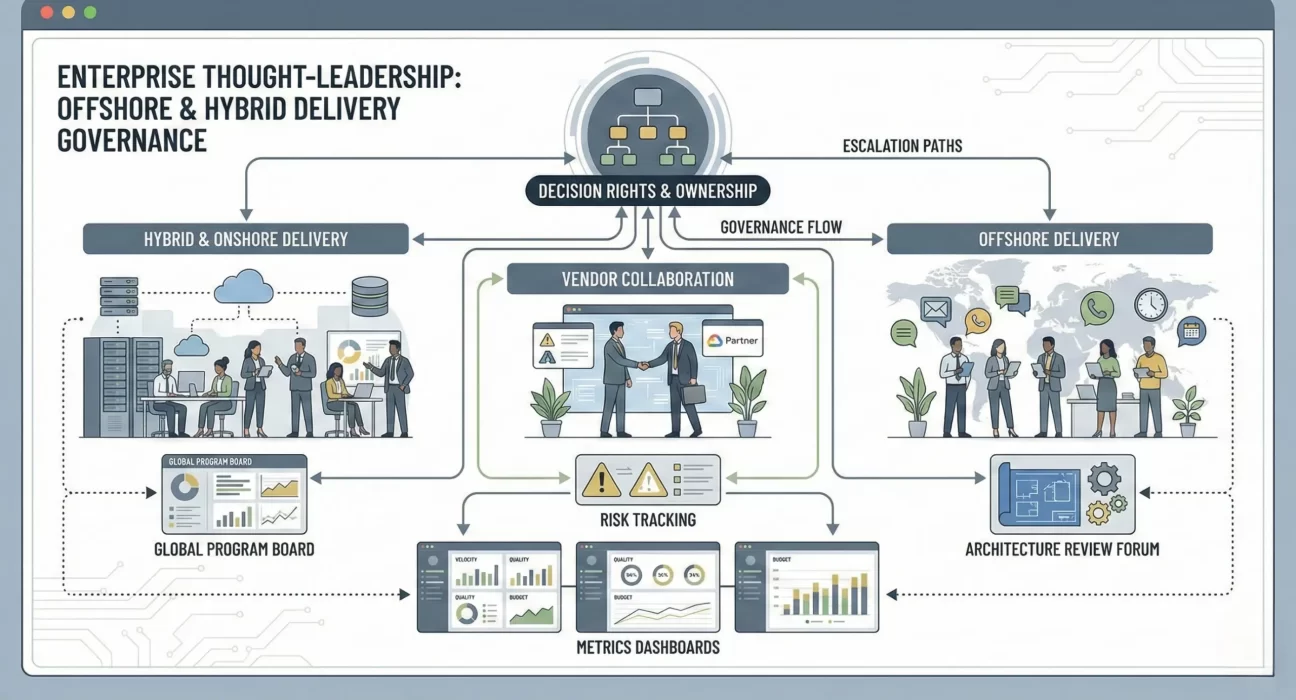
Decision rights are unclear. Who owns the trade-off between speed and quality? Who can approve scope changes? Who decides when to cut a feature versus delay a release? In many programs, these questions don’t have clear answers. So decisions either take too long or get made by the wrong people.
Accountability is diffused. Offshore teams build what’s specified. Onshore teams specify what the business wants. Business wants what they think they need. But when the delivered system doesn’t meet expectations, everyone points at someone else. No single throat to choke.
Communication is assumed, not designed. Weekly status calls aren’t governance. They’re theater. Real governance means structured communication: who needs what information, when, and in what format. It means knowing which decisions can be made asynchronously and which require real-time collaboration across time zones.
Metrics measure activity, not outcomes. Velocity, story points, ticket closure rates- these are useful for teams, but they don’t tell executives what they need to know. Is the program on track to deliver business value? Are risks being managed? Are we building the right thing?
Vendor relationships are transactional. Many enterprises treat offshore partners as interchangeable resources. The contract focuses on rate cards and SLAs, not on outcomes or strategic alignment. When the relationship is purely transactional, you get transactional results.
These problems aren’t new. But they’re persistent because they’re structural, not tactical. You can’t fix them with better tools or more standups. You need a governance model that matches the complexity of what you’re trying to deliver.
What Enterprise-Scale Delivery Actually Requires
If you’re running a transformation program worth tens of crores, with multiple vendors, distributed teams, legacy system dependencies, and hard regulatory deadlines, you need governance that operates at three levels: strategic, operational, and tactical.
Strategic governance is about direction and alignment. This is where the executive sponsor, business owners, and program leadership ensure the initiative remains aligned with business objectives. It’s where trade-offs between scope, time, and cost get made. It’s where risk appetite is defined.
This layer shouldn’t meet weekly. Monthly or quarterly is often enough. But when it meets, decisions must be binding. No “let’s take that offline” or “we’ll circle back.” Strategic governance is where hard calls get made and stuck.
Operational governance is where delivery actually happens. This is the layer that coordinates between onshore and offshore teams, manages dependencies, tracks progress, escalates blockers, and ensures quality standards are met. This is where delivery managers, architects, and leads live.
This layer needs structure: clear RACI matrices, defined escalation paths, and regular checkpoint meetings that actually resolve issues rather than just surfacing them. It’s also where tooling matters, not just Jira or Azure DevOps, but how those tools are configured to give visibility into real progress.
Tactical governance is team-level execution. Standups, sprint planning, retrospectives. This is where engineers and analysts do their work. If the operational layer is functioning well, the tactical layer can operate with high autonomy. If it’s not, this layer becomes chaotic.
Most enterprises get tactical governance right because agile practices are well understood. Where they struggle is operational governance, the connective tissue between strategy and execution. And that’s where offshore and hybrid models add the most complexity.
The Offshore Challenge: Distance, Time Zones, and Trust
Offshore delivery isn’t hard because of geography. It’s hard because of context.
When your development team is in Pune or Bengaluru, and your business stakeholders are in Mumbai, Singapore, or New York, you lose the informal mechanisms that make delivery work. You can’t walk over to someone’s desk. You can’t overhear a conversation that changes your understanding of a requirement. You can’t read body language in a video call the way you can in a room.
This context gap creates three persistent challenges:
Requirements are interpreted, not understood. Offshore teams build what’s written in the ticket. But tickets don’t capture nuance. They don’t explain why a feature matters or what problem it’s really solving. So you get software that meets the spec but misses the intent.
Feedback loops are slow. A question raised in Bengaluru at 10 AM might not get answered by New York until the next day. Multiply that across hundreds of decisions, and you’ve added weeks to your timeline without realizing it.
Trust is earned slowly and lost quickly. When teams are co-located, trust builds through daily interactions. When they’re distributed, it has to be built deliberately through transparency, follow-through, and shared success. One missed deadline or miscommunication can set that back significantly.
Hybrid models where part of the team is onshore and part offshore add another layer. Now you have to manage not just distance, but also the perception of a two-tier team structure. If onshore team members are seen as more strategic and offshore as purely execution, you’ve created a cultural problem that will undermine delivery.
The answer isn’t to avoid offshore or hybrid models. The answer is to govern them properly.
What Good Governance Looks Like in Practice
Good governance in offshore and hybrid delivery isn’t complicated. But it is deliberate.
Start with clear ownership. Every major component, integration, and business capability should have a single accountable owner. Not a team. Not a committee. A person. That person may not do the work themselves, but they own the outcome. When something goes wrong, you know who to talk to. When a decision is needed, you know who makes it.
This sounds obvious, but in many large programs, ownership is murky. Product owners own features but not integrations. Architects own the design but not the delivery. Vendors own code but not outcomes. Clear ownership cuts through this.
Design communication, don’t assume it. In a well-governed program, communication isn’t ad hoc. There are defined forums for different types of decisions and information sharing.
For example: a weekly delivery sync where leads from onshore and offshore teams review progress, blockers, and upcoming risks. A biweekly architecture review where technical decisions are made and documented. A monthly business review where delivery is measured against business outcomes, not just technical milestones.
Each of these forums has a clear agenda, attendee list, and decision-making authority. Minutes are circulated. Actions are tracked. This isn’t bureaucracy, it’s how you prevent things from falling through the cracks.
Use metrics that matter. Velocity is useful for teams. But executives need to know: are we on track to go live? Are we managing scope creep? Are we building technical debt we’ll regret later?
Better metrics for governance: planned vs. actual delivery of business capabilities, defect escape rate to production, mean time to resolve production issues, scope change frequency and impact, and percentage of requirements that required rework.
These metrics tell you whether your governance model is actually working. If requirements are constantly being reworked, your upfront analysis is weak. If defects are escaping to production, your quality gates aren’t effective. If scope changes are frequent, your stakeholder alignment is poor.
Invest in the middle layer. The most underinvested part of most enterprise programs is the operational governance layer, the delivery managers, integration leads, and program coordinators who make things happen day to day.
These people are force multipliers. A good delivery manager can absorb ambiguity from the business, translate it into clear direction for offshore teams, and escalate real risks before they become crises. A weak one becomes a bottleneck or, worse, a relay that just passes messages without adding value.
If you’re spending crores on development but skimping on strong delivery leadership, you’re optimizing the wrong thing.
Treat vendors as partners, not resources. Transactional vendor relationships produce transactional outcomes. If your offshore partner is just a body shop, don’t be surprised when they behave like one.
The best offshore partnerships are built on shared risk and reward. Not just time-and-materials contracts, but outcome-based arrangements where the vendor has skin in the game. This changes behavior. Suddenly, quality matters. Delivery timelines matter. Business outcomes matter.
This doesn’t mean every engagement needs to be outcome-based from day one. But it does mean treating your delivery partner as someone who understands your business, not just someone who writes code.
Common Pitfalls and How to Avoid Them
Even with good intent, governance models can fail. Here are the patterns that cause the most damage:
Over-governance. Yes, this is a thing. Some enterprises react to past failures by adding more gates, more approvals, more checkpoints. The result is paralysis. Teams spend more time reporting status than making progress. Decisions take weeks. Innovation dies.
The fix: governance should be light but consistent. Fewer forums, but make them count. Fewer approvals, but make them meaningful.
Under-investment in onshore coordination. Many enterprises offshore the work but don’t invest enough in onshore coordination. They assume the business can write requirements and the offshore team can execute. In reality, you need a strong onshore program and delivery management to bridge that gap.
The fix: budget for onshore delivery leadership as a percentage of your overall program cost. Ten to fifteen percent isn’t unreasonable for complex initiatives.
Ignoring cultural differences. Indian delivery teams often have a different communication style than Western business stakeholders. Directness, escalation norms, and comfort with ambiguity vary. If you ignore this, you’ll misinterpret signals and create friction.
The fix: invest in cultural onboarding for both sides. Make communication norms explicit. Create safe spaces for questions and clarifications.
Lack of technical governance. Business governance gets attention. Technical governance often doesn’t until you’re six months in and realize you’ve built something that won’t scale, won’t integrate, or won’t meet regulatory requirements.
The fix: Establish architectural guardrails early. Define non-functional requirements upfront. Have a technical authority who can say no.
The Role of Leadership in Delivery Governance
Governance models don’t run themselves. They need executive sponsorship that goes beyond ribbon-cutting and steering committee attendance.
Effective executive sponsors do three things:
They break ties. When business and IT disagree on scope, or finance and operations disagree on timeline, someone has to make the call. That’s the sponsor’s job. Not to delegate it, but to make it.
They protect the program. Large enterprises are full of competing initiatives. Resources get pulled. Priorities shift. The sponsor’s job is to shield the program from organizational churn and ensure commitments are honored.
They hold people accountable. If delivery is slipping, if quality is poor, if vendors aren’t performing, the sponsor needs to act. Not micromanage, but ensure accountability exists and is enforced.
Without this level of engagement, governance is just paperwork.
Why Execution Partners Matter
There’s a reason some enterprises consistently deliver complex programs on time and on budget while others struggle. It’s not luck. It’s execution maturity.
Execution maturity comes from experience having built large systems before, having navigated vendor relationships, having managed distributed teams, and having dealt with legacy constraints and regulatory requirements. It comes from knowing what good looks like and having the discipline to insist on it.
This is where a partner like Ozrit can make a difference. Not as a vendor who takes requirements and writes code, but as a delivery partner who brings governance discipline, program maturity, and a track record of executing at enterprise scale. The value isn’t in the hourly rate. It’s in knowing how to structure delivery, how to manage risk, and how to keep programs on track when they start to drift.
Many enterprises learn this the hard way after a failed program, a cost overrun, or a go-live that wasn’t ready. The smarter move is to work with partners who’ve already learned those lessons.
What Success Actually Looks Like
Successful enterprise delivery isn’t about perfect execution. It’s about controlled execution. It’s about knowing where you are, what’s at risk, and what decisions need to be made.
It’s about delivering business value, not just software. It’s about building systems that last, not just systems that launch. It’s about creating capability within your organization, not just dependency on vendors.
And it’s about governance that enables delivery rather than just monitoring it.
If you’re leading a large-scale transformation, offshore or hybrid delivery, the governance model you choose will determine your success more than the technology stack, the methodology, or the vendor you select.
Get governance right, and everything else becomes manageable. Get it wrong, and no amount of talent or budget will save you.
The choice is yours. Choose deliberately.