

Someone three blocks away is selling exactly what you’re looking for right now.
A desk that fits your space perfectly. A bike in your budget. A laptop with the specs you need. Textbooks for the exam you’re preparing for. Furniture that matches your style.
They listed it yesterday. Fair price. Good condition. Ready to sell today.
You’ll never see that listing.
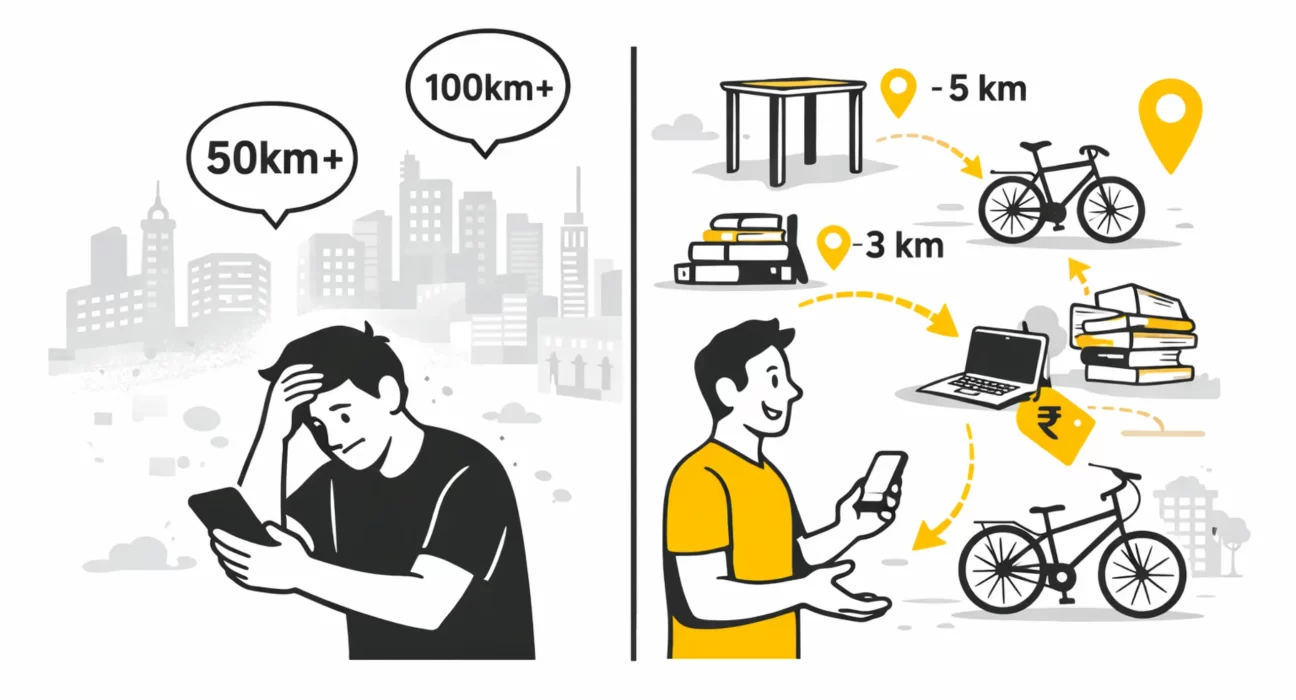
Not because it doesn’t exist. Because the platform you’re using is showing you items from sellers 50 kilometers away, 100 kilometers away, different cities entirely. The algorithm decided those listings are more “relevant” even though you can’t actually go see them.
Meanwhile, the perfect item sitting three blocks away gets buried under hundreds of distant listings you’ll scroll past and forget.
This is the core problem with how most platforms work. They optimize for everything except the one thing that actually matters: connecting you with nearby people who have what you need.
Sympl fixes this by doing something radical. It only shows you what’s actually local.
The Illusion of Infinite Choice
Open any major marketplace app. Search for “study table.” You get 847 results.
Sounds great, right? Options. Choices. Competition driving prices down.
Except here’s what actually happens.
You start scrolling. The first ten listings look promising. You click into one. The seller is in a different city. Next one. Same thing. Third one. Same city as you, but across town an hour away in traffic.
You keep scrolling. Results 11-20. Half are overpriced. Two are in your area but the photos are terrible so you can’t tell if they’re any good. One looks perfect but was posted three months ago and probably sold already, the seller just didn’t remove the listing.
Results 21-30. You’re getting tired. Everything is starting to look the same. You can’t remember which ones you already looked at.
By result 40, you’ve forgotten what you’re even looking for. You’ve seen so many tables that none of them seem right anymore. Decision fatigue sets in.
You close the app. You’ll look again later. You don’t.
This is what infinite choice actually feels like. Not empowering. Exhausting.
The platform gave you 847 options and somehow you still didn’t find what you needed. Not because it wasn’t there, but because the signal-to-noise ratio was so bad that finding the right listing became harder than just buying new.
What Local Actually Solves
Now imagine searching and seeing only listings from sellers in your area. Not your entire city. Your actual neighborhood and adjacent areas.
Instead of 847 results, you get 12.
That’s not limiting. That’s clarifying.
Twelve listings you can actually evaluate. Twelve sellers you can actually meet. Twelve real options instead of 847 theoretical ones.
You click the first one. The seller is fifteen minutes away. Posted two days ago. Photos are clear. The price is fair. You message them. They reply in twenty minutes. You agree to meet tomorrow at a coffee shop between both your locations.
You show up. The table is exactly as described. You inspect it. Looks good. You hand over cash. You load it in your car or arrange a quick delivery. Done.
Total time from search to purchase: less than 24 hours. Total effort: minimal. Total stress: almost none.
This is what locals enable. Not just convenience, actual completion of transactions. The kind where you go from needing something to owning it without the process consuming your entire week.
Most platforms brag about selection. Sympl focuses on completion. Because what good is having access to a thousand listings if you never actually buy anything?
Why Distance Kills Deals
You find a great bike. The price is right. Photos look good. The seller seems responsive.
There’s one problem: they’re 40 kilometers away.
You message anyway. “Is this still available?”
They reply: “Yes, interested?”
You ask if they can meet halfway. They say they don’t have transport. Can you come to them?
You check the route. It’s an hour each way in traffic. Two hours total for a bike you haven’t even seen yet. If you get there and don’t like it, you’ve wasted an entire evening.
You suggest meeting on the weekend. They’re not free. You offer Sunday. They prefer Saturday. You go back and forth trying to find a time that works for both of you.
Eventually you agree on next Saturday afternoon. Great.
Wednesday arrives. They message: “Someone else is coming to see it tomorrow. If they buy it, sorry.”
Thursday evening. “Sold. Thanks anyway.”
You just spent a week coordinating with someone who sold it to the first person who could show up immediately. Because that person was local. You weren’t.
Distance creates delays. Delays create opportunities for deals to fall apart. This happens constantly, and both buyers and sellers get frustrated.
Sympl eliminates this entirely. If someone messages you, they’re nearby. If they’re serious, they can come see it today or tomorrow. No week-long coordination. No competing with local buyers who have the geographic advantage. Just fast, simple transactions between people who can actually meet.
The Real Cost of Browsing
Let’s talk about what you’re actually spending when you scroll through hundreds of listings.
Time is obvious. You spend an hour browsing, comparing, clicking, reading descriptions. An hour you could have spent doing literally anything else.
But there’s a hidden cost: decision fatigue.
Every listing you evaluate drains a tiny bit of cognitive energy. Is this one good? How does it compare to the last one? Should I keep looking or settle for this? What if something better appears if I scroll more?
These aren’t big decisions. But you’re making dozens of them. By the time you’ve scrolled through 50 listings, your brain is tired. Your judgment gets worse. You either make a poor choice or give up entirely.
Neither outcome is good.
Then there’s opportunity cost. While you spent an hour browsing 100 listings, someone else messaged a local seller about a listing they saw in 30 seconds, met them that evening, and bought exactly what they needed.
They’re done. You’re still looking.
Platforms that flood you with options think they’re being helpful. They’re not. They’re creating work. And most of that work is wasted because the majority of listings you’re seeing aren’t actionable anyway.
Sympl respects your time differently. Fewer listings, all local, all recent, all actionable. You see twelve options instead of 847, but those twelve are actually worth evaluating. That’s the trade worth making.
How Platforms Trick You Into Wasting Time
Ever notice how marketplace apps are designed to keep you scrolling?
Infinite scroll. Always more listings below. Just keep going. Maybe the perfect item is just a few more swipes away.
Recommendation algorithms. “People also viewed…” showing you six more listings you didn’t search for but now feel obligated to check.
Filters that don’t actually filter well. You select “within 5km” and still get results from 20km away because the platform decided those were “relevant.”
Notifications designed to pull you back in. “New listing matching your search!” Except it’s not really a match, and it’s not really new, and it’s definitely not nearby.
All of this keeps you engaged with the app. More time in-app means more data collected, more ads potentially shown, better metrics for the platform.
But it doesn’t help you buy what you need. It just keeps you busy.
This isn’t accidental. Platforms optimize for engagement. Time spent in-app. Number of listings viewed. Click-through rates. These metrics make investors happy.
They don’t make users happy. But as long as users keep coming back, the platform considers it working.
Sympl operates differently. The goal isn’t keeping you in the app. It’s getting you out of the app with the item you needed. Fast in, fast out, transaction complete.
If you spend five minutes on Sympl and buy exactly what you need from someone ten minutes away, that’s success. You’re not supposed to browse for an hour. You’re supposed to find it and buy it.
What Buyers Actually Want (It’s Not Complicated)
Strip away all the platform marketing. What do people actually want when buying used items?
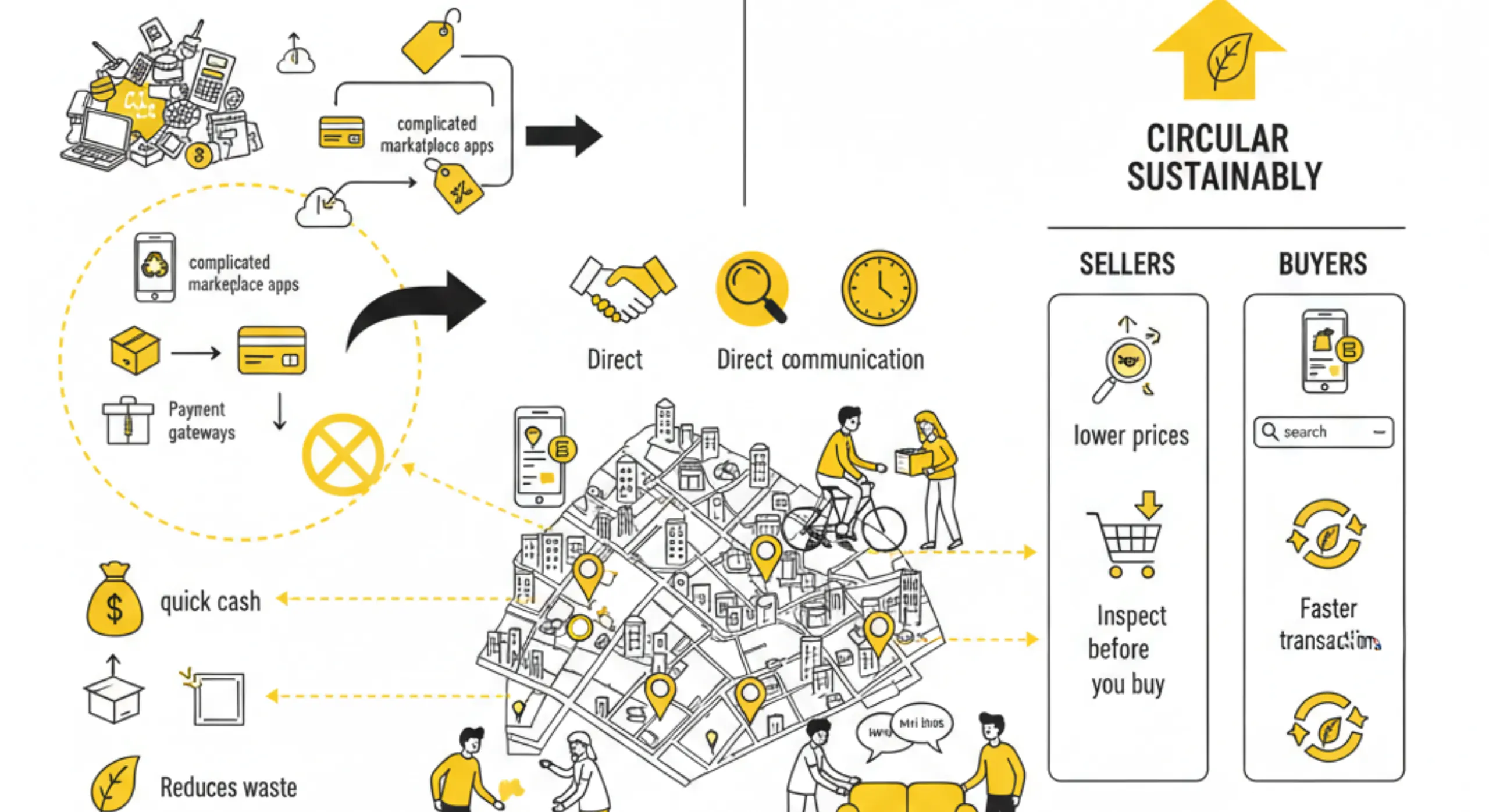
See what’s available nearby. Not theoretically available if they’re willing to coordinate long-distance pickups. Actually available from sellers they can meet easily.
Evaluate options quickly. Not scroll through hundreds of listings. See a manageable number of real options and make a decision.
Inspect before buying. Meet the seller. Check the item. Ask questions. Verify it’s as described. Then buy it right there.
Complete the transaction fast. From searching to owning in days, not weeks. Buy what they need and move on with their life.
Pay a fair price. Not the cheapest possible price. Fair for the condition and age of the item. They’ll pay reasonable money for reasonable goods.
That’s it. That’s the list.
Notice what’s not on it: algorithm-curated recommendations, seller rating systems, 47 different filter options, in-app payment processing, shipping integrations, social features.
Users don’t want platforms to be sophisticated. They want platforms to be useful.
Sympl delivers useful information. Everything on that list above? Sympl does it. Everything not on that list? Sympl skips it.
The Neighborhood Marketplace That Should Exist
Think about how local commerce used to work before the internet.
You needed a desk. You asked neighbors. Someone knew someone who was selling one. You got a phone number. You called. You went to see it. You bought it or you didn’t.
Simple. Direct. Based on proximity and word-of-mouth.
The internet should have made this easier. Instead, most platforms made it complicated by trying to scale it nationally.
But some things don’t benefit from the national scale. Buying a used desk isn’t better because you have access to desks across India. It’s better when you have access to quality desks near you that you can go see today.
Sympl brings back the neighborhood marketplace model. It just uses technology to make it work better.
Instead of asking neighbors, you search the app. Instead of word-of-mouth, you see direct listings. Instead of calling, you message. But the core remains: local people buying and selling to each other based on proximity and actual availability.
This isn’t nostalgia. It’s recognizing that the old model worked for good reasons, and scaling it nationally actually made it worse for most use cases.
When National Platforms Make Sense
To be fair, national marketplaces have their place.
Buying rare collectibles? You might need national reach because only three people in India are selling what you want.
Selling specialized equipment? Your local area might not have buyers. Going national makes sense.
Running an actual business reselling items? You want maximum reach and you’re equipped to handle shipping logistics.
But regular people doing one-off transactions? National reach creates more problems than it solves.
You’re not trying to find the absolute cheapest desk in India. You’re trying to find a decent desk nearby that you can pick up this weekend. National platforms can’t optimize for that because their entire structure is built around scale, not locality.
Sympl is built for the 90% of transactions where locale makes more sense. The student is buying textbooks. The family is selling a bike. The professional upgrading phones. The person furnishing a new apartment.
These scenarios don’t benefit from seeing listings from across the country. They benefit from seeing quality listings from across the neighborhood.
What Changes When Everything Is Local
Local-only isn’t a limitation. It’s a feature that changes the entire dynamic.
Prices become realistic. Sellers can’t play games because buyers can see competing local listings easily. Buyers can’t lowball excessively because sellers have other local options. Market forces work at neighborhood scale.
Communication improves. No one’s asking about shipping. No one’s trying to coordinate across time zones. Just: “Can you meet tomorrow?” “Yes, 5 PM at this location work?” “Perfect.”
Trust develops naturally. You’re meeting in person in your city. Both parties are locally accountable. The transaction feels more human, less anonymous.
Deals close faster. No logistics to figure out. No waiting for shipping. Meet, inspect, buy, done. What should take days actually takes days instead of stretching into weeks.
The platform fades into the background. It connected you. Now you’re just two people completing a transaction. The platform did its job by getting out of the way.
This is what Sympl enables. Not by adding features, but by removing everything that doesn’t support local transactions.
Your Next Purchase Is Closer Than You Think
Right now, someone within walking distance has exactly what you’re looking for.
They priced it fairly. They’re ready to sell. They’re just waiting for someone local to message them.
You’re looking for exactly what they’re selling. You’re willing to pay a fair price. You’re ready to buy.
The only thing between you and that transaction is the platform you’re using.
If it’s showing you 800 listings from across the city and beyond, you’ll never find the one three blocks away. It’s buried. Lost in the noise.
When Sympl launches, that changes.
Search for what you need. See what’s actually near you. Message the seller. Meet them. Buy it.
The way it should work. The way it used to work. The way it’s about to work again.
Locality isn’t a limitation. That’s the entire point.